Nolus Earn USDC pool, live
- USDC Earn rate (APY)
- –
- Share of the pool lent out
- –
Stablecoin yield is the interest you earn by lending stablecoins such as USDC to people who want to borrow them, or a reward a platform offers for keeping them there.
Where that yield comes from decides how safe it is. This article looks at four places to lend USDC on Solana: Nolus Earn, Kamino, Jupiter Lend and Save. Where the wider industry is the better yardstick, it widens the view to Aave, a lending app on Ethereum, and to Coinbase. The rates are as they stood on October 20, 2026.
On Nolus, the yield is the interest users pay to borrow for positions that hold real assets. There are no token emissions (new tokens handed out as a reward), no points and no lockup.
Where Stablecoin Yield Comes From
Stablecoin yield comes from one of three places, and each carries a different kind of risk.
Interest From People Who Borrow
A lending pool collects deposits and lends them out. The people who borrow pay interest, and depositors earn from it. Stablecoin interest rates move with how much of the pool is lent out: when more people borrow, the rate goes up, and when fewer do, it falls. All five lending apps in this article work this way.
Token Rewards
Some apps add rewards on top: new tokens they hand out, or points that may turn into tokens later. Rewards lift the rate while they last, but they are paid in a token whose price can fall, and they can end at any time.
Exchange Rewards
An exchange can also pay you for keeping a stablecoin on its platform. Here the exchange sets the rate and the terms, and it holds your coins. It can change or end the reward whenever it likes: as of December 2025, Coinbase pays USDC rewards only to customers with a paid Coinbase One membership, and everyone else stopped earning them on December 15, 2025.
What Can Go Wrong
Every way of earning on a stablecoin carries risk. Four matter most.
The Code
A lending pool is software, and any software can have a bug. That is true of every app in this article, Nolus included.
Getting Your Money Out
On any lending app you can only withdraw what isn't lent out at that moment. When a pool is nearly fully lent, you wait for borrowers to repay. On Nolus, liquidity comes back to the pool as positions pay interest, close or are trimmed.
Leaving your coins with a company rather than a pool adds a different risk. In 2022, several crypto lending platforms that paid high yields paused withdrawals and then went bankrupt, and their customers were left waiting for their money.
That day, Nolus had the most free to withdraw as a share of its pool, about 29%. It is also a far smaller pool than the others, so the same share is a smaller amount.
Borrowers Who Can't Pay It Back
If a borrower's position loses value, the pool needs that position sold before it is worth less than the loan. On Nolus, each position holds the real asset it bought. Three on-chain warnings come first. Then a partial liquidation sells only enough to bring the position back to health: liquidations trim, they don't erase. And Nolus liquidates on the trend, not the wick, as Market Anomaly Guard explains.
On October 10, 2025, when crypto markets crashed, the Nolus protocol took on no bad debt, meaning no loan was left bigger than what its position sold for. That was before its USDC pool on Solana opened.
The Coin Itself
A stablecoin is only as stable as what backs it. In March 2023, USDC lost its $1 peg, trading at $0.92 on one exchange, after Silicon Valley Bank collapsed and its issuer, Circle, said $3.3 billion of its reserves was stuck there. That risk is the same on every app here, because they all hold the same USDC.
How Nolus Earn Works
You deposit USDC into the pool, and the pool lends it to users who open positions. Each of those users pays a rate fixed for the life of their position, with no funding fees (how a fixed rate compares with perps' funding). The interest builds up in the pool and compounds automatically, with nothing to claim.
There is no lockup, no notice period and no withdrawal fee: you can withdraw whatever isn't lent out, at any time. There are no token emissions, no points and no IOU: the stablecoin yield on Nolus is interest users pay.
Your rate is not fixed: it moves with demand. The live figures at the top of this page come from the same source as the Earn table in the app. Nolus Earn takes assets other than USDC too; the app lists them.
What USDC Yield Pays on $1,000
Follow one $1,000 deposit for 30 days at each app's rate that day. Every rate is an APY, the yearly rate with compounding included, so the dollar figures compare like for like.
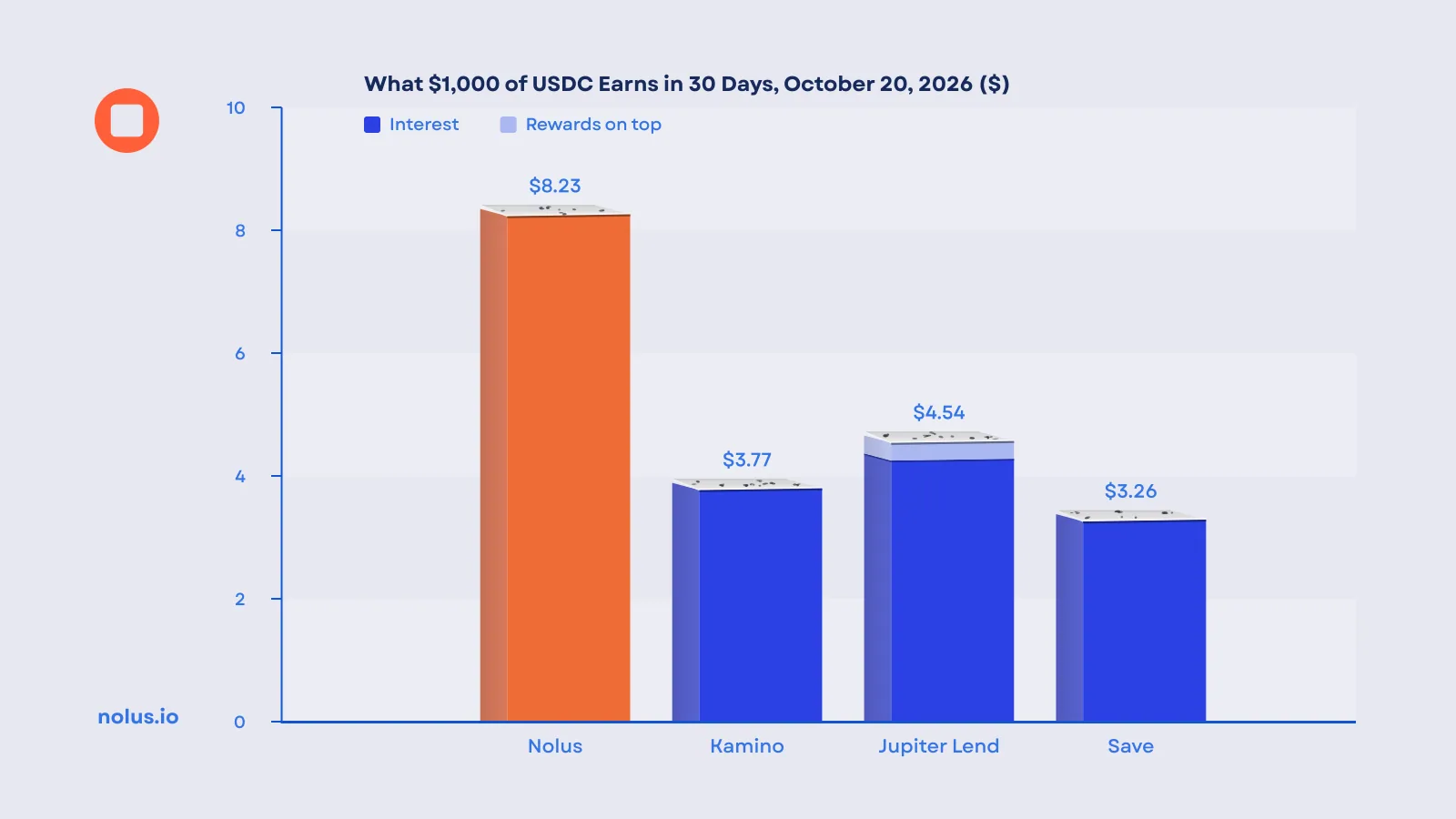
On the day, Nolus paid the most, $8.23 on $1,000 for 30 days, and Save the least of the four, $3.26. Treat that as a snapshot: every one of these rates moves with demand, and the figures at the top of the page show where Nolus stands today.
The rest of the comparison fits in a few words per app. Aave and Coinbase join the table here as the wider yardstick.
| Nolus | Kamino | Jupiter Lend | Save | Aave | Coinbase | |
|---|---|---|---|---|---|---|
| Rate (APY) | 10.49% | 4.68% | 5.67% | 4.04% | 3.86% | Coinbase One only |
| From loans or rewards? | Loans | Loans | Loans + 0.37% rewards | Loans | Loans | Rewards |
| Locked up? | No | No | No, limits apply | No | No | Held by Coinbase |
| Free to withdraw now | About 29% | 6% | 9% | 19% | 6% | n/a |
Loans means the yield is interest paid by users who borrow from the pool. Free to withdraw is the share of each pool not lent out on the day: about 64,000 USDC on Nolus, against 3.9 million to 149 million USDC on the others. Coinbase sets its own rate for paying Coinbase One members (as of December 2025).
When Each Fits
- Kamino, Jupiter Lend and Save run far larger pools than Nolus, so a big deposit moves their rate less and a big withdrawal is easier to fill. Jupiter Lend also added a small reward on top on the day.
- Coinbase fits if you want your USDC to stay on an exchange and you pay for Coinbase One.
- Nolus Earn fits if you want yield from users' fixed-rate positions that hold real assets. On the day, it paid the highest rate in the table.
Nolus Earn's stablecoin yield comes from users who borrow for positions that hold real assets, and it compounds automatically. You can withdraw what isn't lent out at any time. Borrowers get three warnings, and their positions are trimmed rather than closed, on the trend, not the wick. The real cost is size: the pool is small, about 64,000 USDC free that day against millions elsewhere, so a large deposit or withdrawal moves it more. And like every rate here, yours is not fixed: it moves with demand.
Sources
- Nolus: the Nolus data API's
/api/pools, the source of the app's Earn table and of the live figures on this page; October 10, 2025 - Kamino: Kamino API, main market, USDC reserve
- Jupiter Lend: Lend API and Earn on Jupiter Lend
- Save: Save API, main market, and Supply & Borrow APY
- Aave: Aave API, Aave v3 Ethereum core market, USDC
- Coinbase: Decrypt, "Coinbase Ending USDC Rewards for Free Users"
- 2022: Federal Reserve Bank of Chicago, "A Retrospective on the Crypto Runs of 2022"
- March 2023: Fortune, "Circle reveals it has $3.3 billion stuck at Silicon Valley Bank"
- All rates were read on October 20, 2026 between 11:02 and 11:03 UTC, each as an APY. The dollar figures compound that APY over 30 days on $1,000. The share free to withdraw is what the pool held unlent against what it held in total.
Frequently asked questions
What is stablecoin yield?
It is what you earn for putting stablecoins to work: interest from people who borrow them through a lending app, or a reward an exchange or app pays you for keeping them there. Where it comes from decides how safe it is.
How do you earn interest on stablecoins?
Deposit them into a lending pool, where borrowers pay interest and depositors earn it, or hold them on an exchange that pays a reward. On a lending app the rate moves with how much of the pool is lent out.
Does USDC pay interest?
Not by itself. USDC sitting in a wallet earns nothing. The yield comes from lending it out, or from a reward a platform chooses to pay.
Can you stake USDC?
Not the way you stake a coin like SOL. What apps call earning on USDC is lending: your USDC is lent to people who borrow it, and you earn from the interest they pay.
Is stablecoin yield safe?
No yield is free of risk. There are four main ones: a bug in the code, not being able to withdraw while most of a pool is lent out, borrowers whose positions lose value before they can be sold, and the stablecoin itself losing its peg to the dollar.
Can I withdraw from Nolus Earn at any time?
Yes. There is no lockup, no notice period and no withdrawal fee. You withdraw from the part of the pool that isn't lent out, and liquidity comes back as positions pay interest, close or are trimmed.
Why do stablecoin interest rates change?
Because they follow demand. When more of a pool is lent out, borrowers pay more and depositors earn more; when fewer people borrow, rates fall. Rewards that start or end move the rate too.