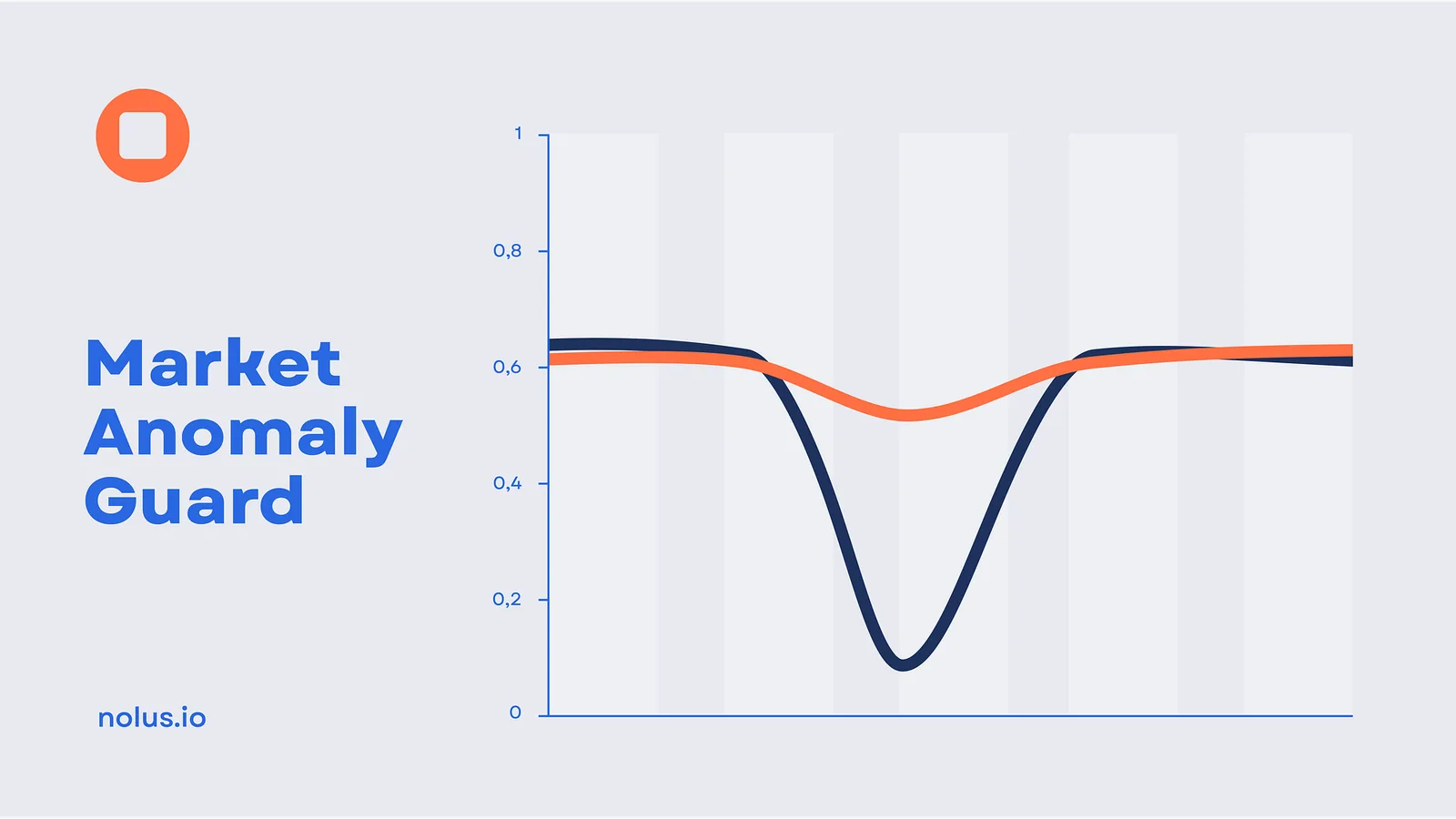
Volatility is a double-edged sword in crypto: it creates opportunities for big gains, but also for sudden losses. At Nolus, we believe in maximizing opportunity while minimizing unnecessary risk. That’s why we’re introducing Market Anomaly Guard (MAG): a smart safeguard designed to shield users from unfair liquidations triggered by erratic pricing during market chaos
The Problem: Swapping During Market Chaos
When crypto markets become volatile, asset prices can temporarily diverge across exchanges and liquidity pools. Arbitrage usually corrects these gaps, but not instantly. For a brief window, a DEX might display a price significantly below the market average.
Now imagine this:
- A user’s leverage position on Nolus hits the liquidation threshold.
- The protocol attempts a partial liquidation by swapping a fraction of the collateral on a DEX.
- But that DEX shows a temporarily depressed price: far lower than Nolus’ oracle-based EMA (Exponential Moving Average).
This can lead to over-liquidation, where more of the user’s position is sold than truly necessary, causing unfair loss for the user and potential bad debt for the protocol.
The Solution: Market Anomaly Guard (MAG)
To prevent such scenarios, we developed MAG, a price-protective algorithm that smartly evaluates liquidation risk before executing a swap.
How It Works
1. Triggering a Liquidation
When a position crosses the liquidation threshold (determined by an EMA to avoid reacting to momentary dips), liquidation is attempted.
2. Minimum Output Requirement
Before executing the swap, the protocol simulates the trade. If the expected output (i.e., what the user would get post-swap) falls below a defined safety threshold, the liquidation is paused.
3. Waiting for Better Prices
MAG then enters a watchful state:
- If prices recover and the output improves → the liquidation resumes and finalizes.
- But here’s the game-changing part:
If the asset price rises back above the liquidation trigger, the liquidation is fully canceled!
Why This Matters
This cancellation logic is a major innovation.
✅ It gives users a second chance: Instead of liquidating at a temporarily bad price, MAG buys time for the market to correct itself.
✅ It favors users in volatile “knife-drop” scenarios: Sudden sharp drops often bounce quickly, MAG is designed for that.
✅ It reduces unnecessary liquidation churn: Less damage to user portfolios, fewer penalties, and a smoother trading experience.
✅ It protects the protocol: By avoiding poorly-priced swaps that could lead to protocol losses.
A Real-World Analogy
Think of MAG like a smart auto-sell filter with built-in patience. Most protocols act like panic sellers: “Price is low? Sell now!”
MAG instead asks: “Is this really the best price we can get right now?”
If the answer is no, it waits. And if prices bounce? 💥 Your liquidation is canceled. Your position survives. That’s not just liquidation management. That’s user-aligned, intelligent DeFi.
Why Nolus Is Different
Unlike rigid protocols that:
- Use spot price only
- Liquidate immediately and fully
- Offer no protection once triggered
Nolus applies:
✅ EMA smoothing to avoid false liquidation triggers
✅ Swap output simulation before execution
✅ Liquidation cancellation if market recovery occurs
This creates a dynamic, fair, and user-centric liquidation mechanism
With Market Anomaly Guard, Nolus redefines how liquidations should work. Instead of rushing to sell at the first sign of weakness, it waits, evaluates, and gives your position a second life when possible.
This is how Nolus turns volatility from a threat into a survivable event for both users and the protocol
Stay smart. Stay safe. Stay on Nolus
Frequently asked questions
What is Market Anomaly Guard?
Market Anomaly Guard, or MAG, is a check Nolus runs before executing a liquidation swap. The protocol simulates the trade first, and if the expected output falls below a safety threshold, meaning the venue is quoting far off the oracle's moving average, the liquidation is paused rather than executed.
Can a liquidation be cancelled after it has been triggered?
Yes. While MAG holds a liquidation, it keeps watching price. If the quote recovers enough to clear the safety threshold, the liquidation resumes and completes. If price rises back above the liquidation trigger entirely, the liquidation is cancelled and the position stays open.
Why would a liquidation execute at a bad price in the first place?
In sharp moves, prices diverge across exchanges and pools faster than arbitrage closes the gap, and a single venue can briefly quote well below the wider market. Liquidating into that quote sells more of the position than the real market price requires, which harms the user and can leave bad debt with the protocol.
Does this mean I cannot be liquidated on Nolus?
No. MAG protects against liquidating into a distorted price, not against genuine adverse price movement. If the market truly moves against a position and stays there, the liquidation proceeds. The safeguard buys time for a bad quote to correct, it does not remove liquidation risk.