Strategies
What a Leveraged SOL Trade Really Costs
Every leveraged position carries four costs: getting in, holding, getting out, and being wrong.

Every leveraged position carries four costs: getting in, holding, getting out, and being wrong. Interest gets the attention because it is the number every app prints on the front page. The other three are where the apps actually differ.
This article prices one trade on four Solana lending apps, Nolus, Kamino, Jupiter Lend, and Save, using each app's published terms and its live rate on September 17, 2026.
The short version: Nolus costs more to hold, and much less when the market turns.
The Same Trade, Four Apps
A trader puts in $1,000 and opens a 2.5x long on SOL: $2,500 of SOL, $1,500 borrowed, with SOL at $101. All four apps swap through the same Solana liquidity, so the cost of the swap that gets the trade in and out is broadly the same everywhere and is left out of the table, as is the network fee of a few cents per transaction.
| Nolus | Kamino | Jupiter Lend | Save | |
|---|---|---|---|---|
| Fee to open | $0 | $0.02 | $0 | $1.50 |
| Fee to close | $0 | $0.02 | $0 | $0 |
| Interest for 30 days | $9.60 | $6.84 | $5.68 | $7.00 |
| Can the rate change? | No, fixed at open | Yes | Yes | Yes |
| Earned on the SOL over 30 days | $0 | $9.12 | $7.60 | $6.45 |
| SOL can fall this far before a liquidation | 33% | 20% | 29% | 17% |
| Penalty per $1,000 of collateral sold | $0 on a partial liquidation | $10 to $100 | $10 | $49 to $69 |
| Highest leverage | 5x | 3.8x | 5x | 2.9x |
| Drop that liquidates at the highest leverage | 11% | 1.3% | 5.9% | 9.7% |
Fees, liquidation levels, and leverage limits are each app's terms on September 17, 2026, and interest is computed at that day's rates. Rates on every app move daily. The one on a Nolus position is fixed for that position at the moment it opens.
Getting In and Out
Nolus charges nothing to open a position and nothing to close one. The protocol's margin sits inside the interest rate shown on the position form, so there is no second charge to find. Jupiter Lend charges nothing to open or close either. Save takes 0.10% to borrow USDC, which is $1.50 on the $1,500 in this trade, and Kamino's leverage product costs about two cents each way in flash loan fees.
For reference, Aave charges 0.25% on swaps made through its own app. Fees beyond interest are small on every app in this comparison. They do not decide it.
Holding
This is where Nolus costs more today. Thirty days of interest on the $1,500 borrowed comes to $9.60 on Nolus, against $5.68 on Jupiter Lend, $6.84 on Kamino, and $7.00 on Save.
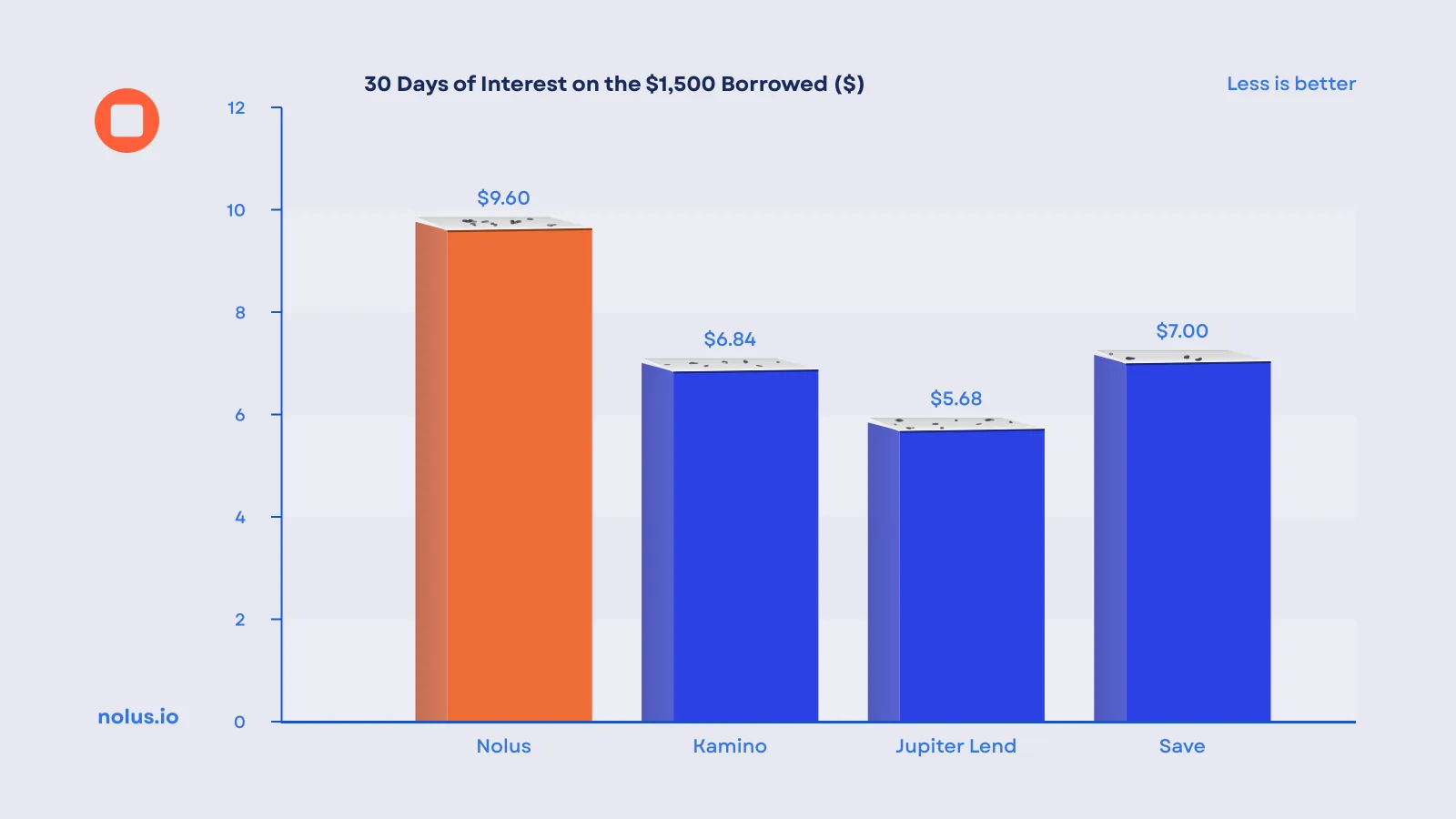
There is a second cost. On Kamino, Jupiter Lend, and Save, the SOL bought with the borrowed money keeps earning the app's supply rate while it sits as collateral, and that offsets part of the interest. On Nolus the asset backing a position earns nothing. At the rates of the snapshot, a Kamino or Jupiter Lend position came out roughly two dollars ahead over the month, and a Nolus position paid its $9.60 in full.
What Nolus offers is not a lower rate but a known one. The rate on a Nolus position is set when it opens and does not change for the life of that position. The other three charge a variable rate that moves with how much of the pool is borrowed: quiet when demand is quiet, climbing when it is not. Kamino's SOL borrow rate, by its own curve, reaches 36% when the pool is fully lent out. A short trade in a quiet market costs less on a variable rate. A position held through a busy market is where the fixed rate earns its keep.
When SOL Falls
Leverage is priced by what happens when the trade goes wrong, and here the picture reverses.
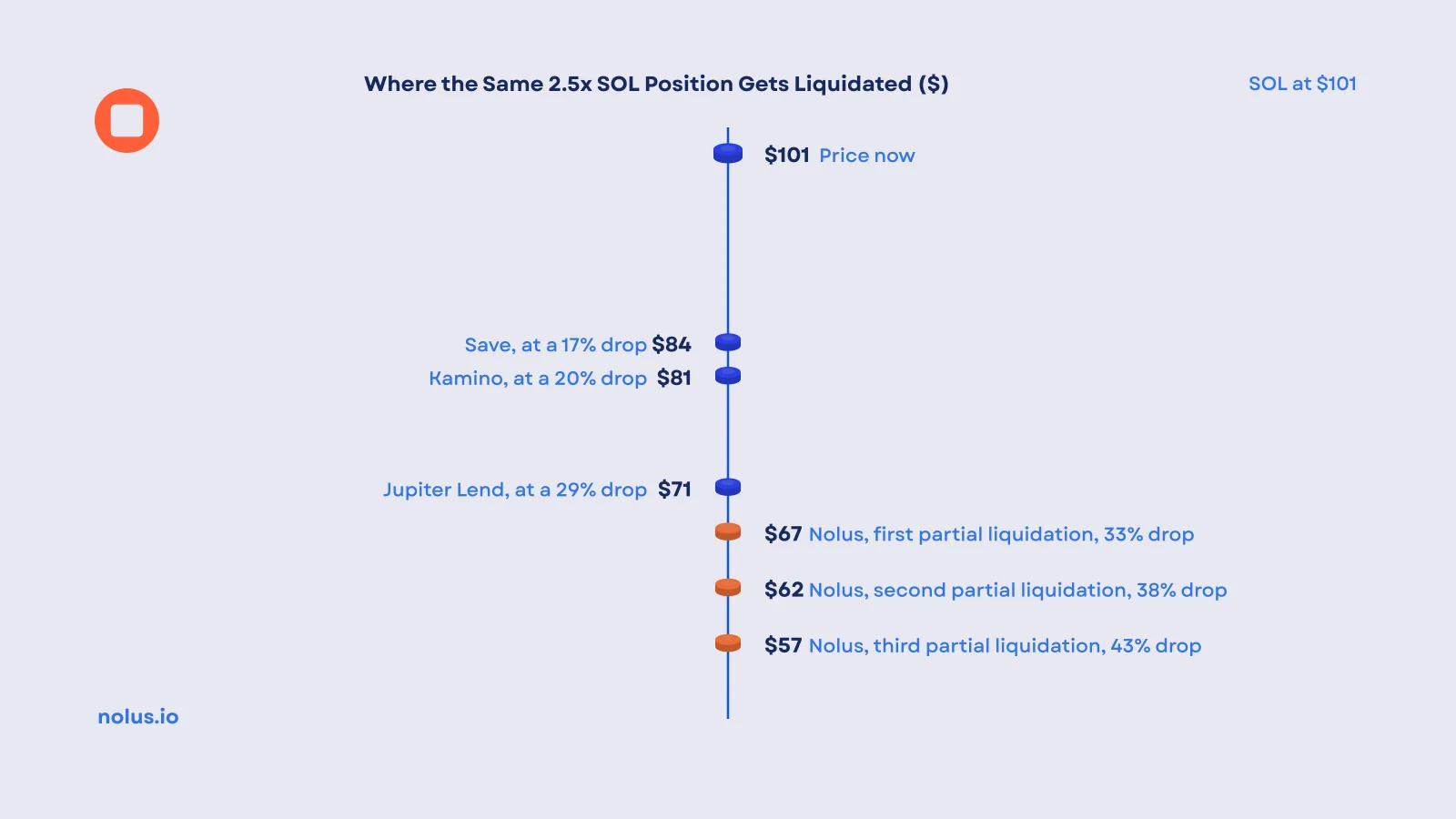
At 2.5x, SOL can fall 33% before a Nolus position reaches its first liquidation line, to about $67 from $101. On Jupiter Lend the line sits at a 29% drop, on Kamino at 20%, and on Save at 17%.
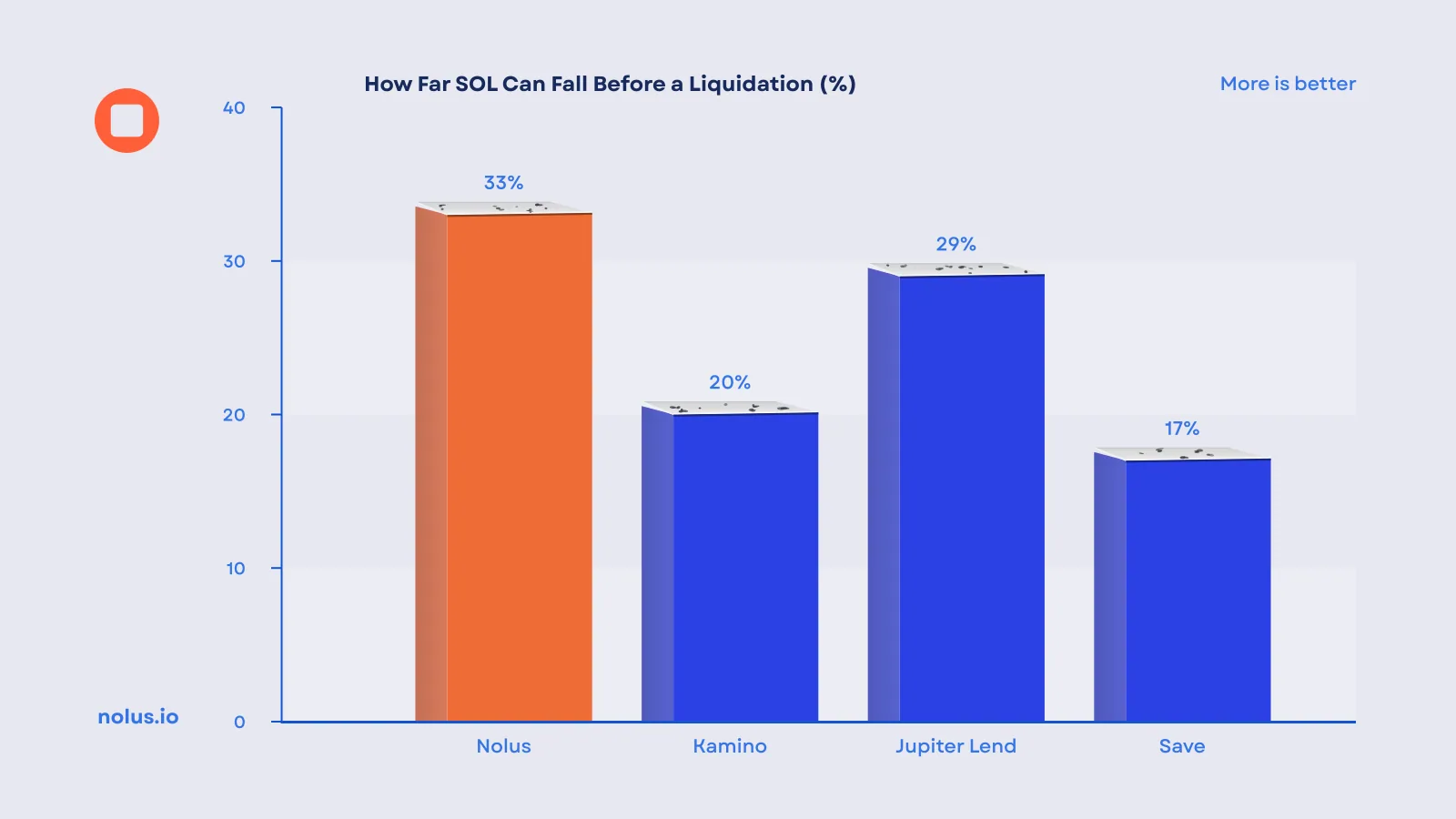
For Nolus, 33% is the nearest liquidation line, not the end of the position. A Nolus liquidation is partial: it sells only as much collateral as it takes to bring the position back to a healthy level, at the market price, and the position stays open. The next slice comes only if SOL keeps falling, at about 38% below the opening price, and a third at about 43%. The position form lists these liquidation prices before a position opens.
The same holds at each app's highest leverage. Nolus and Jupiter Lend both go to 5x, Kamino stops at 3.8x, and Save at 2.9x. At those limits a Nolus position survives an 11% drop before liquidation, Save 9.7%, Jupiter Lend 5.9%, and Kamino 1.3%.
What a liquidation costs differs even more. Kamino, Jupiter Lend, and Save also liquidate in slices rather than closing the whole position; the difference is what each slice costs. Nolus charges no penalty on a partial liquidation. For every $1,000 of collateral sold, Jupiter Lend charges $10, Kamino $10 at the line and up to $100 the further past it a position has slipped, and Save $49 to $69. On the Ethereum lending apps the range is $45 to $75 on Aave, $44 on Morpho's cbBTC market, and $50 to $100 on Compound. On Kamino, Save, Aave, and Compound, part of that penalty is kept by the protocol itself.
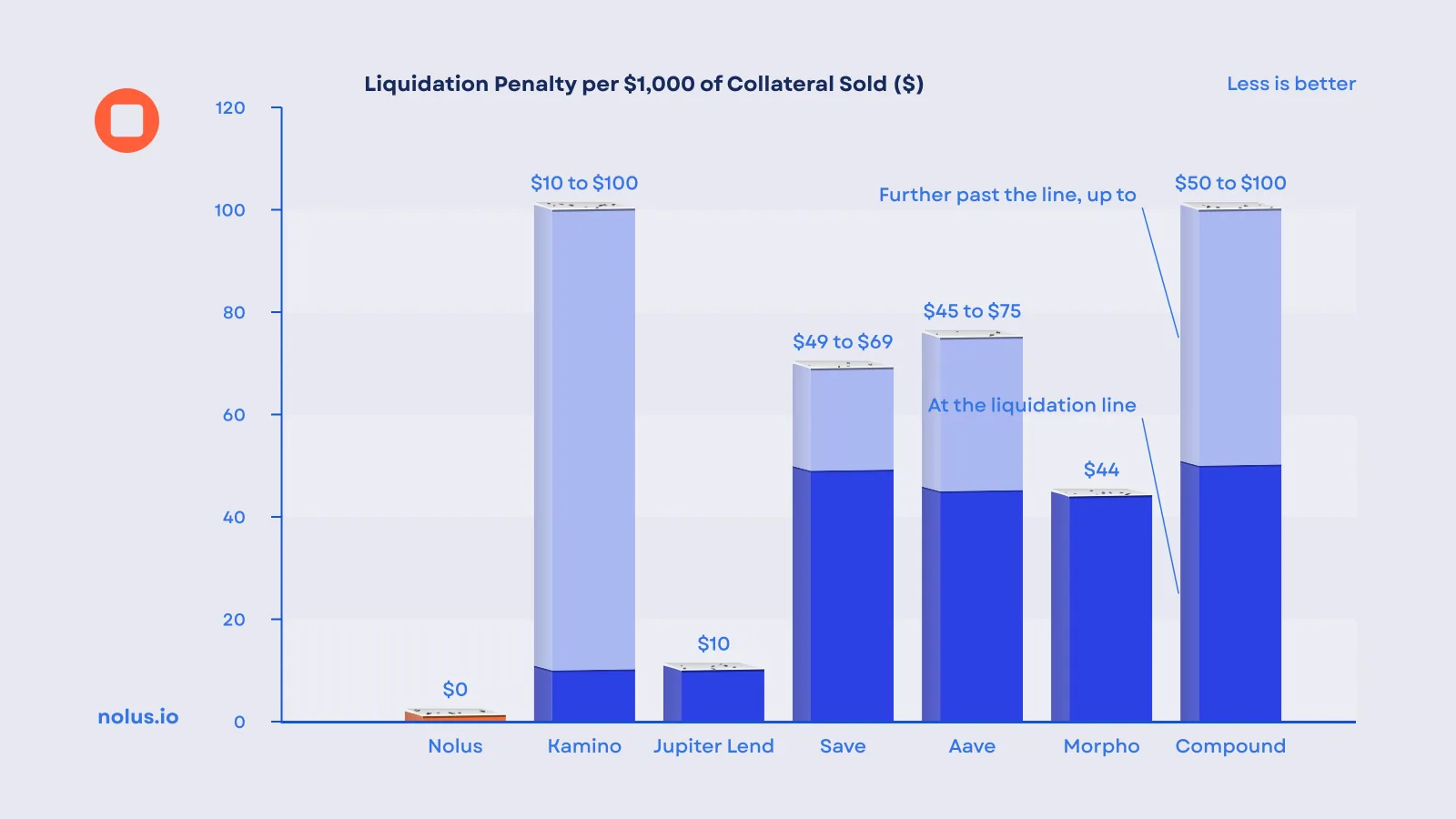
Liquidations trim on Nolus; they do not erase. A dip takes a slice, not the position.
For Lenders
The pricing difference has a mirror image on the lending side. On Nolus the pool rate goes to lenders in full; the protocol's margin is charged to the borrower on top of it rather than taken out of it. Aave, Kamino, Jupiter Lend, and Save keep between 10 and 50% of the interest borrowers pay before anything reaches lenders. Compound keeps the gap between its borrow curve and its supply curve. Morpho takes nothing at the market level, though the vault curators between a lender and the market take 0 to 25%.
What It Adds Up To
Over a month, Nolus costs a few dollars more to hold than the least expensive of the four, and it pays nothing on the asset it buys. It costs less to enter, less to exit, and a great deal less on the day the market turns against the position. None of that is hidden in a fee schedule. It is the design: a rate fixed the moment a position opens, a liquidation line further away, and a liquidation that takes a slice at the market price instead of a penalty. Rates on all four apps will keep moving. The shape of the trade-off is set by design, not by the market.
Sources
- Nolus: Liquidations & risk and Borrowing
- Kamino: Liquidations and Fees & Interest Rates
- Jupiter Lend: Borrow and Liquidation Mechanism
- Save: Liquidations and Fees
- Aave V3: Pool contract, liquidationCall and Swap features
- Morpho: Liquidation
- Compound III: Liquidation
- Interest rates, pool parameters, and liquidation terms were read from each app's public API and on-chain state on September 17, 2026, with SOL at $101. Where an app's documentation and its on-chain parameters differ, the on-chain value is used.
Read next in
Strategies
 Strategies
DeFi Leverage Compared: Fixed Rates vs Funding
A structural comparison of leveraged DeFi protocols: interest rate design, liquidation behavior, and the fees that quietly decide realized returns.
4 min read Strategies
Leveraged Spot vs Perpetual Swaps: Cost and Risk
Funding rates versus fixed interest, pooled counterparty risk versus a shared lending pool, and why open interest caps limit perpetual markets.
4 min read Explainers
How to Manage Risk in Crypto Lending on Nolus
Keeping your loan-to-value low, topping up collateral in time, and how partial liquidations and third-party audits limit the downside on Nolus.
6 min read