Explainers
28 posts tagged Explainers
 Explainers
Hyperliquid Fees: What a Position Costs to Open and Hold
Hyperliquid fees in plain words: trading fees, fee tiers, app fees and funding, and what $1,000 down on a 2.5x SOL long paid for a month next to Nolus
 Explainers
Cross Margin vs Isolated Margin: Why Your Account Needs Bulkheads
Ships survive a leak because bulkheads keep it in one compartment. What cross margin and isolated margin do when one position springs a leak, and how Nolus keeps it afloat
 Strategies
Stablecoin Yield: Where It Comes From and What It Pays
Where stablecoin yield comes from, what can go wrong, and what $1,000 of USDC earns on Kamino, Jupiter Lend, Save and Nolus Earn
 Strategies
What Is a Funding Rate? Perps vs a Fixed Rate on Nolus
Funding rates in plain words, and what holding one SOL position for a month cost on two perps venues next to the fixed rate on Nolus
 Strategies
Kamino vs Jupiter vs Nolus: Leveraged SOL Costs
One 2.5x SOL trade priced on Kamino, Jupiter Lend, Save and Nolus: what it costs to get in, hold and get out, in a calm month and a bad one
 Deep Dives
When the Weakest Link Isn't the Code
In April 2026, Drift Protocol lost $285M in 12 minutes, not to a smart contract exploit. The attack pattern has shifted from breaking code to compromising control
 Metrics
October 2025 Crash: How Nolus Liquidations Compared
Liquidation intensity and portfolio reduction across Aave, Kamino, Hyperliquid, dYdX and Nolus during the sharpest deleveraging event to date
 Explainers
How Misconceptions Shape Our Views on Crypto
Have you ever heard that goldfish have only a three-second memory? Or that humans use just 10% of their brain?
 Explainers
Why Mindset Matters Even More in Crypto
In the world of crypto, mindset is not just a nice-to-have, it’s essential
 Metrics
Tiresome, vague, and lazy: Why TVL is not the be-all and end-all of metrics
The DeFi space has long used Total Value Locked (“TVL”) as the primary indicator of the success of a protocol (e.g.
 Explainers
Demystifying DeFi, risky business or not
The crypto community has become very familiar with super-high APRs on all primitives from spot exchanges to money markets to perpetual
 Explainers
The Evolution of Money Markets: Banks to DeFi
How lending moved from institutions to peer-to-peer platforms to on-chain money markets, and where leveraged spot positions fit in that line
 Interop
A Game-Changer for DeFi Liquidity Fragmentation
Unifying Digital Assets to Enhance Liquidity and User Experience
 Explainers
Rug Pulls: Navigating the Pitfalls
Ensuring the security of your investments means understanding the nuances of rug pulls in the evolving world of crypto and DeFi
 Deep Dives
How to Avoid Liquidation: Partial vs Full
What triggers a liquidation, how to work out your liquidation price, and why Nolus sells only part of a position first instead of closing it all
 Explainers
How to Manage Risk in Crypto Lending on Nolus
Keeping your loan-to-value low, topping up collateral in time, and how partial liquidations and third-party audits limit the downside on Nolus
 Interop
The Future of IBC
As a value-bridging protocol, IBC has been a massive boon to the Cosmos ecosystem
 Explainers
The Role of Network Governance on Nolus
The Cosmos ecosystem prides itself on sovereignty and the ability of appchains to govern themselves through on-chain governance
 Deep Dives
How does Nolus solve the issue of liquidity?
Nolus inherits liquidity from the chains it connects to via Interchain Accounts instead of running its own exchange, and pools lender deposits in one market
 Explainers
FOMO, FUD, and DYOR
Cryptocurrency investing can be an exciting and potentially lucrative endeavor
 Tokenomics
What makes “Good Tokenomics”
Tokenomics should be transparent and easy to understand
 Interop
Lending Within the Cosmos Ecosystem
Why Nolus uses a single shared pool, cash-basis interest, and its own appchain instead of the over-collateralized model most Cosmos lenders run
 Explainers
Staying Safe in a Trustless Environment
With more projects spawning every day, staying safe within the cryptocurrency space should be a top priority!
 Interop
Finding Liquidity in the Cosmos
The majority of cryptocurrencies are volatile assets whose prices fluctuate for a number of reasons
 Explainers
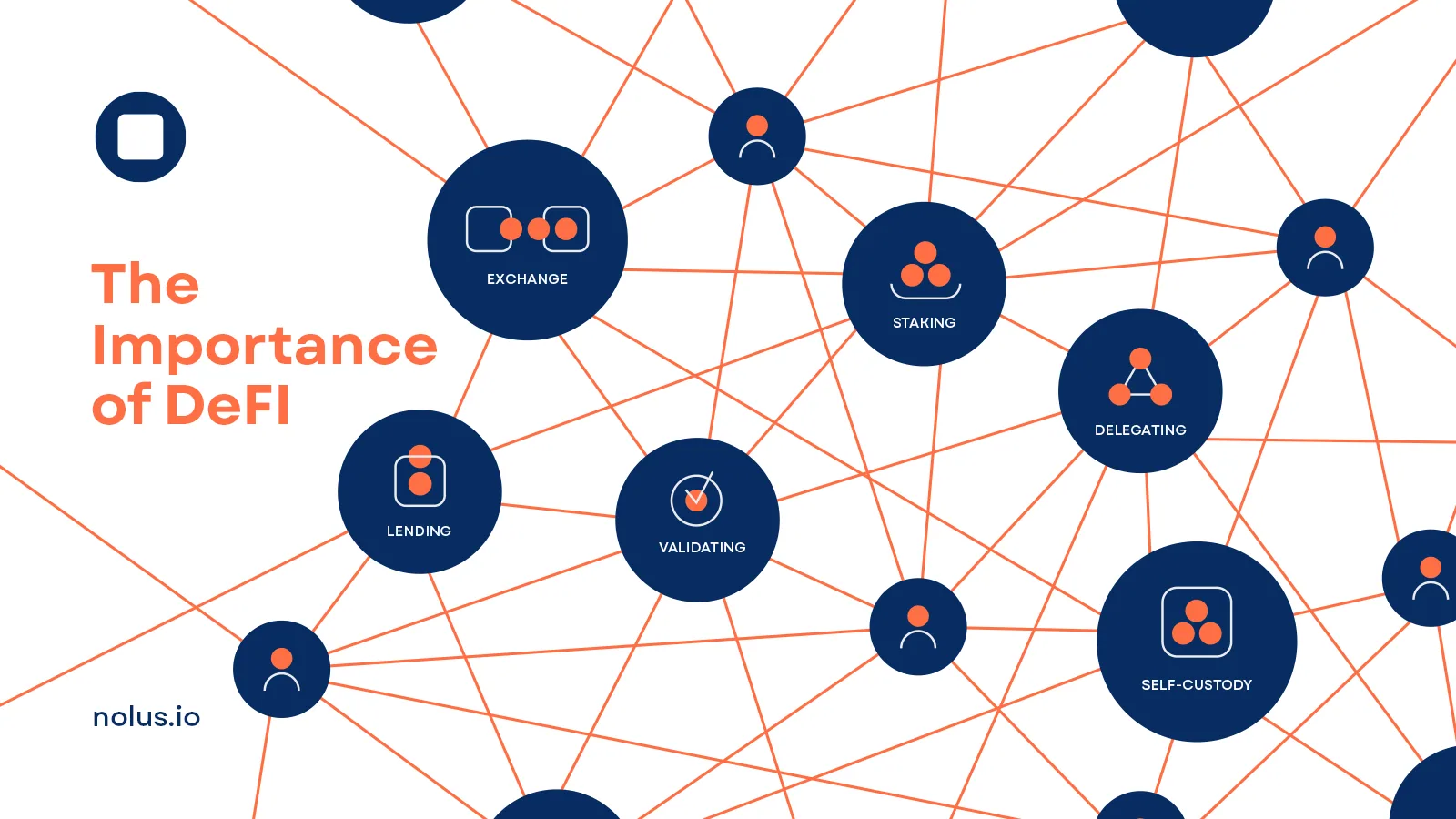
The Importance of DeFi
Decentralized finance offers an open and free alternative for consumers
 Tokenomics
NLS Token: Utility, Staking, Supply, and Market Data
What NLS does, how staking works, how the 1 billion token supply is structured, and where circulating supply and market cap stand as of August 2026
 Deep Dives
How Does Nolus Work? Fixed-Rate Spot Margin, Explained Step by Step
A plain walkthrough of a Nolus position: how the fixed borrowing rate is set, how leverage is capped, how lenders get paid, and how buybacks fund the rewards
 Explainers
Six Problems With Crypto Lending
Over-collateralization, full liquidations, lost ownership and high costs are the standing problems in crypto lending. Here is how Nolus answers