Hyperliquid fees are 0.045% for an order that fills at once (a taker order) and 0.015% for one that waits on the order book (a maker order) on perpetual futures, or perps, and 0.070% and 0.040% on spot, at the base tier.
Each fee is charged on the full size of the position, not on the money you put down, which is called your margin. The rate drops once you trade more than $5 million over 14 days or stake HYPE, Hyperliquid's own token. Apps and some markets can add to it, and holding a perp also costs funding every hour. The rates here were checked against Hyperliquid's fee schedule and Phantom's help page on October 21, 2026.
This article covers three ways to hold the same position: Hyperliquid directly, Hyperliquid through Phantom (Hyperliquid is the venue behind the perps in the Phantom wallet), and Nolus. The fee to get in is the small, known part. On a position held for a month, the hourly funding decides the bill, and nobody can quote it in advance. On Nolus the rate is fixed at open, and there are no funding fees.
Hyperliquid Fees at a Glance
| Question | On Hyperliquid |
|---|---|
| What does an order that fills at once cost on perps? | 0.045% |
| And an order that waits on the order book? | 0.015% |
| What about spot? | 0.070% at once, 0.040% waiting |
| What is the fee charged on? | The full position size, not your margin |
| When does the rate drop? | Above $5 million of trading in 14 days, with HYPE staking (5 to 40% off), or with a referral code (4% off your first $25 million) |
| Can an app add its own fee? | Yes, up to 0.1% on perps (Phantom adds 0.05%) |
| Do some markets cost more? | It depends on the market. Markets listed by outside teams set their own rate, from about 0.0045% up to 0.27%, so check the fee shown |
| What does holding a position cost? | Funding, every hour. A $2,500 SOL long paid $14.71 in September 2026 |
| Is there gas on each order? | No |
| Is there a fee to start? | 1 USDC, once, on a new account's first deposit |
| What does a withdrawal cost? | $1 per USDC withdrawal, per Hyperliquid's docs |
| Is there a liquidation fee? | No, but a last-resort (backstop) liquidation keeps the maintenance margin, the least the position had to hold |
Hyperliquid Trading Fees: Orders That Fill Now and Orders That Wait
An order that fills at once takes a price someone else has already posted; Hyperliquid calls it a taker order. An order that waits posts your own price on the order book, the list of prices people are willing to buy and sell at, and fills when someone takes it; that is a maker order. Waiting costs a third as much, 0.015% against 0.045%, but the order may not fill when you want it to.
Hyperliquid fees are charged on the full position, not on the money you put down. Put in $1,000 at 2.5x leverage and the position is worth $2,500, so each market order, the kind that fills at once, costs about $1.13. Opening and closing with market orders costs $2.25, and with limit orders that wait, $0.75.
| The same $1,000 | 2.5x | 5x | 10x |
|---|---|---|---|
| How big is the position? | $2,500 | $5,000 | $10,000 |
| What does opening and closing with market orders cost? | $2.25 | $4.50 | $9.00 |
| What did funding cost in September 2026? | $14.71 | $29.42 | $58.84 |
The more leverage you take, the more both costs grow, and funding grows fastest in dollars.
Spot, where you buy the token itself rather than a perp, costs 0.070% for an order that fills at once and 0.040% for one that waits. Pairs between two of Hyperliquid's spot quote assets, the assets other tokens are priced in, such as USDC, pay 80% less on orders that fill at once.
Fee Tiers and How to Pay Less
Hyperliquid fees fall in steps as your trading volume grows:
| Trading in the last 14 days | Order that fills at once | Order that waits |
|---|---|---|
| $5 million or less | 0.045% | 0.015% |
| Over $5 million | 0.040% | 0.012% |
| Over $25 million | 0.035% | 0.008% |
| Over $100 million | 0.030% | 0.004% |
| Over $500 million | 0.028% | 0% |
| Over $2 billion | 0.026% | 0% |
| Over $7 billion | 0.024% | 0% |
Volume is counted over the last 14 days and checked at the end of each day, UTC. Spot volume counts double. Sub-accounts share the main account's tier, but vaults do not. Reaching the first step takes more than $5 million of trading in two weeks, so the base tier is the rate to plan on.
Staking HYPE takes a share off every fee:
| Tier | HYPE staked | Off your fees |
|---|---|---|
| Wood | Over 10 | 5% |
| Bronze | Over 100 | 10% |
| Silver | Over 1,000 | 15% |
| Gold | Over 10,000 | 20% |
| Platinum | Over 100,000 | 30% |
| Diamond | Over 500,000 | 40% |
You can stake from a separate account and link it to the one you trade from, but the link is permanent, and it gives the staking account power over the trading account's funds.
A referral code takes 4% off your fees, but only on your first $25 million of trading, not for life, and not for vaults or sub-accounts. The discounts multiply: with Silver staking and a referral code, 0.045% becomes 0.045% × 0.85 × 0.96, about 0.037%.
Hyperliquid also pays a small rebate on orders that wait, but only to the largest market makers, those behind more than 0.5% of all such volume on the exchange.
Fees Added by Apps and Outside Markets
Two things can push the rate you pay above 0.045%.
Apps that send your orders to Hyperliquid can add a fee of their own, which Hyperliquid calls a builder fee. It is capped at 0.1% on perps and 1% on spot, and you approve the most each app may charge before it can charge anything.
Markets listed by outside teams (HIP-3 markets, in Hyperliquid's terms) set their own extra share on top of the base fee, so the rate depends on the market. A 100% share doubles the fee for an order that fills at once to 0.09%, and the 300% maximum takes it to 0.27%. Markets in growth mode, which crypto markets can't use, go the other way: 0.0045% to 0.009%, 5 to 10 times less than the base. The fee shown before you confirm is the one to go by.
Hyperliquid Fees Through Phantom
Phantom's perps run on Hyperliquid, so Hyperliquid fees apply, with Phantom's own fee on top. Phantom lists 0.095% for opening, adding margin to, closing or partly closing a position: 0.05% for Phantom plus Hyperliquid's 0.045%. That roughly doubles the base trading cost, so opening and closing a $2,500 position costs $4.75 instead of $2.25. Phantom notes that fees can vary by order type, market and account tier, and that equity and other outside-listed markets can add deployer fees, set by the team that listed the market.
Moving money in and out of the perps balance costs something too. Phantom's help page lists that Hyperliquid charges a 1 USDC fee on your first deposit and another on your first withdrawal, and later deposits and withdrawals cost a 0.07% Hyperliquid spot swap fee plus a network fee.
Phantom perps aren't available in the US, the UK and some other territories.
Funding: What Holding a Position Costs
Funding is a fee that users holding a perp pay each other every hour, to keep the perp's price close to the asset's real price. When more people bet on a rise (go long), the longs pay; when more bet on a fall, the other side pays. It is charged on the full position, and Hyperliquid takes no cut. In calm markets it sits at a small default which, on a $2,500 position, comes to about $22.50 a month, paid by longs. Hours when longs are paid pull most months below that.
On the example position below, SOL funding cost $14.71 in September 2026. Its most expensive month in the past year was August 2026, at $18.44. How funding rates work explains who pays it and why it swings.
Gas, Deposits and Withdrawals
Outside trading and funding, Hyperliquid fees are few. Placing an order on Hyperliquid costs no gas, the small fee many crypto apps charge for every action. Priority fees exist, but they are optional and meant for users who need an order through faster.
A new account pays 1 USDC once, on the first deposit into it. Hyperliquid's docs put the withdrawal fee at $1 per USDC withdrawal, worded as the fee "at the time of this writing", and its FAQ says you need 1 USDC for withdrawals.
Where Hyperliquid Fees Go
Hyperliquid fees go to three places: HLP, a vault that users can deposit into; the Assistance Fund; and the teams that list outside markets. The Assistance Fund turns the fees it receives into HYPE and burns them, removing those tokens for good. For live totals, see Hyperliquid on DefiLlama; they change every day, so they are not copied here.
One Month Held: $1,000 Down on a 2.5x SOL Long
Now follow one position. On September 1, 2026 you put down $1,000 and open a $2,500 SOL long at 2.5x, with SOL at about $103, and close it on September 30 with SOL at $118.05. On Hyperliquid both orders are market orders at the base tier, with no discounts, and as in the funding article, fees and funding are counted on a steady $2,500. On Nolus the position borrows $1,500 at 8.0% a year, the rate quoted at open, and that rate stays the same until the position closes. Nolus charges no fee of its own to open or close. The position buys real SOL, and the swap that buys it and sells it back carries a small cost, about 18 cents for the round trip on this size, measured on October 21, 2026.
| Nolus | Hyperliquid | Through Phantom | |
|---|---|---|---|
| How big was the position? | $2,500 | $2,500 | $2,500 |
| What did it cost to open and close? | About $0.18, the swap that buys and sells the SOL (no Nolus fee) | $2.25 | $4.75 |
| What did holding it cost in September 2026? | $9.86 | $14.71 | $14.71 |
| What did the month cost in total? | $10.04 | $16.96 | $19.46 |
| Its most expensive month in the past year? | $10.04 (the rate is fixed at open) | $20.69 (August 2026) | $23.19 (August 2026) |
| Could the holding cost change while you held it? | No, fixed at open | Yes, every hour | Yes, every hour |
| What is the holding cost charged on? | The $1,500 borrowed | The full $2,500 | The full $2,500 |
Nolus has only been on Solana since late August 2026, so the Nolus column shows this one position at the rate it got, not a year of Nolus history.
Deposits and withdrawals are left out of the table. Directly on Hyperliquid, a new account pays 1 USDC on its first deposit and, per Hyperliquid's docs, $1 per withdrawal; through Phantom, 1 USDC on the first deposit and 1 USDC on the first withdrawal, then 0.07% plus a network fee.
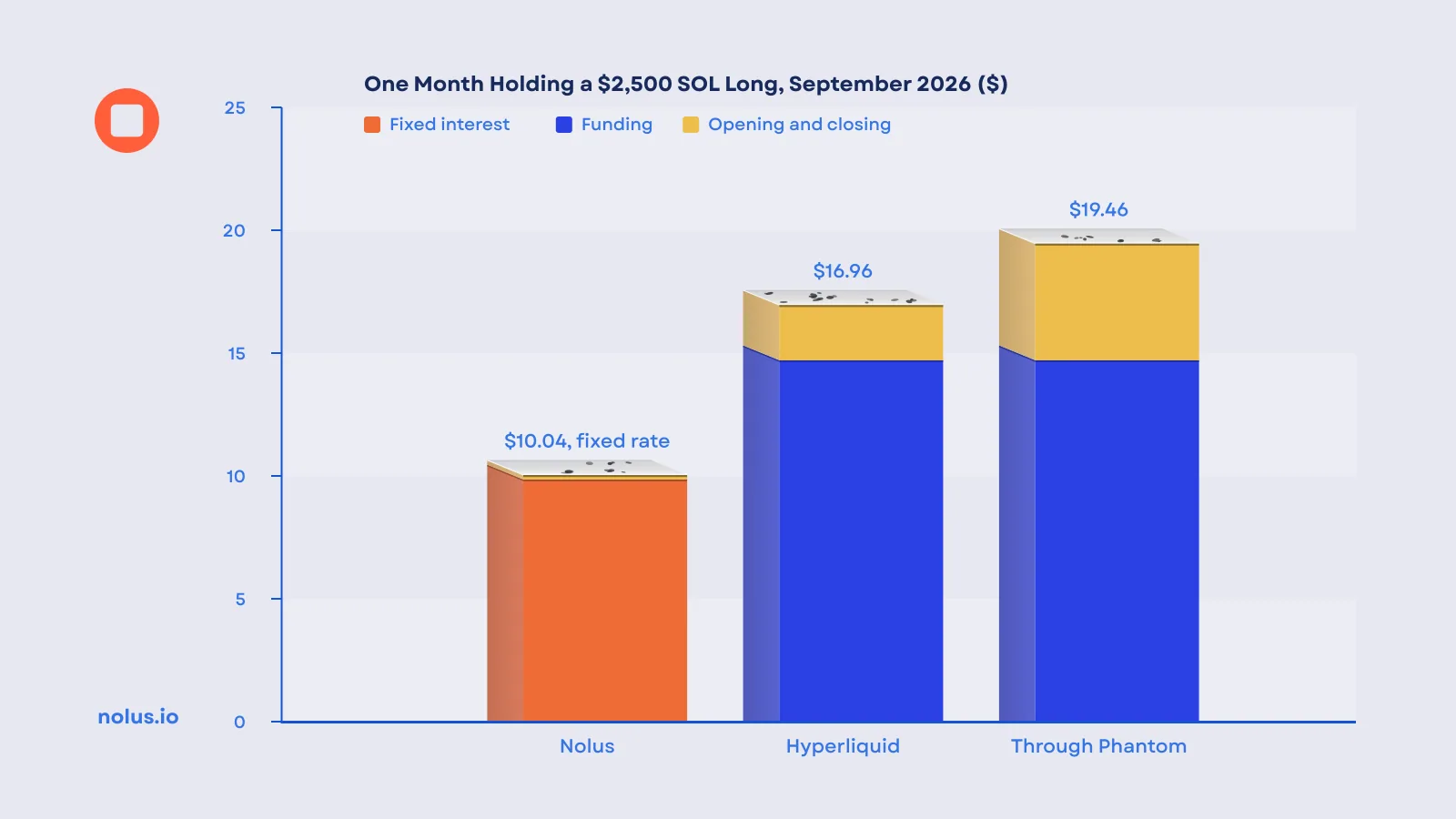
Trading fees are the small part: funding was about 87% of the month on Hyperliquid directly. Of the 12 months to September 2026, longs paid funding in 6. In 2 of those, January and May 2026, the direct Hyperliquid month cost less than this Nolus position's $10.04; through Phantom, none did. Hyperliquid's totals include trading fees, so they are set against the Nolus interest plus its swap.
In 6 other months funding was negative, so the long was paid to hold. That usually means more people were betting on a fall, and the market was moving against the position: SOL fell in 4 of those months and barely moved in the other 2. What the fixed rate buys is knowing the cost on day one. The rate a new Nolus position gets depends on how busy the lending pool is on the day it opens: under the pool's settings on September 1, this position could have paid anywhere from $9.25 to $17.47 in interest for a month like September.
When Each Fits
Hyperliquid fits when:
- You hold for hours or days, so the hourly funding stays small next to the price move you are after.
- You can place orders that wait on the order book, at a third of the fee.
- You want more leverage: up to 20x on SOL, against up to 5x on Nolus.
- You want a wide choice of markets.
Nolus fits when:
- You hold for weeks or months and want to know your cost on the day you open. The rate is fixed at open, there are no funding fees, and interest runs only on the part you borrow.
- You want no margin calls, with nobody asking you to top up the position.
- You want liquidations to start small. A liquidation is when a position is sold because the price fell too far. On Nolus, liquidations trim, they don't erase: the first sells only part of the position, with a $0 penalty on a partial liquidation, as what a leveraged SOL trade really costs shows. Hyperliquid does not charge a liquidation fee; the difference is how much gets sold, which cross margin vs isolated margin walks through.
- You want liquidations to follow the trend, not the wick, a brief dip in price. Before Nolus sells, the position is re-assessed on a fresh price.
- You want the position to hold the asset. A Nolus position holds real SOL, so you can pay it off and keep the asset, or settle into stables and walk away.
- You hold more than one position. Every Nolus position is isolated: each position has its own collateral and its own liquidation, and a liquidation on one never affects another. Phantom's perps are isolated too, and Hyperliquid offers isolated margin alongside cross margin, where positions share one balance.
What you are choosing between is who carries the uncertainty. On Nolus the rate is fixed at open, there are no funding fees and no margin calls, and every position is isolated. Liquidations trim, they don't erase, with a $0 penalty on a partial liquidation, and they follow the trend, not the wick. The position holds the real SOL, so you can keep it or settle into stables. What Nolus gives up is the calmer months, when a perp can cost less than a fixed rate.
Sources
- Hyperliquid docs: Fees, Funding, Builder codes, Referrals, Liquidations, Margining, How to start trading, Priority fees, Activation gas fee and Exchange endpoint and the FAQ Withdrawing to Phantom wallet (withdrawals)
- Hyperliquid info API:
userFeesfee schedule,metaandcandleSnapshot, read on October 21, 2026 - Phantom: Trade perps in Phantom, Understanding perp trading in Phantom and Phantom Perps
- DefiLlama: Hyperliquid
- Nolus: Borrowing and Liquidations & risk
- Fees, tiers and Phantom's rates as published on October 21, 2026. Funding is every hourly SOL fee Hyperliquid charged from October 1, 2025 to September 30, 2026, added up by calendar month on a $2,500 position. The Nolus rate is the one the protocol quoted for this position at 00:00 UTC on September 1, 2026, with SOL at $103.
Frequently asked questions
What are Hyperliquid fees?
Hyperliquid fees on perps are 0.045% for an order that fills at once and 0.015% for one that waits on the order book, and on spot 0.070% and 0.040%, at the base tier. More trading volume, HYPE staking and a referral code lower them. Fees added by apps, and some markets listed by outside teams, can raise them.
What is the difference between maker and taker fees on Hyperliquid?
A taker order fills at once, at a price someone else has already posted, and pays the higher fee. A maker order posts your own price on the order book and waits for someone to take it, and pays the lower fee. Both are charged on the full size of the position.
How can I lower my Hyperliquid fees?
Use orders that wait on the order book, trade enough to reach a lower volume tier, stake HYPE, or use a referral code. The staking and referral discounts multiply together, and the referral discount only covers your first stretch of trading.
Does Hyperliquid charge gas or withdrawal fees?
There is no gas on orders. A new account pays 1 USDC once, on its first deposit, and Hyperliquid's docs put the withdrawal fee at $1 per USDC withdrawal.
What does Phantom charge for perps?
Phantom lists 0.095% for opening, adding margin, closing or partly closing a position: 0.05% for Phantom plus Hyperliquid's 0.045%. Phantom notes that fees can vary by order type, market and account tier, and markets listed by outside teams, such as equities, can add fees of their own.
How does Hyperliquid make money?
Hyperliquid fees go to HLP, a vault users can deposit into, to the Assistance Fund, and to the teams that list outside markets. The Assistance Fund turns its share into HYPE and burns it. Hyperliquid takes no cut of funding, which users pay each other.
Does Nolus charge trading fees or funding?
Nolus has no funding fees: users pay a fixed interest rate, set at open, on the part they borrow. Nolus charges no fee of its own to open or close a position; the swap that buys and sells the asset has its own cost.