Introduction
So far, the growth of Decentralized Finance (DeFi) has stemmed from the creation of new blockchains and protocols that are not interoperable. These large monolithic networks have caused liquidity within crypto to be fragmented across each ecosystem, resulting in the majority of protocols operating in a “silo”. In order for DeFi to reach the tipping point of mass adoption, these protocols must be able to communicate and transact, irrespective of what blockchain they are built on.
At Nolus, we believe in a blockchain-agnostic DeFi future, and we are strongly positioned to advance forwards with the next major frontier of Web3 development.
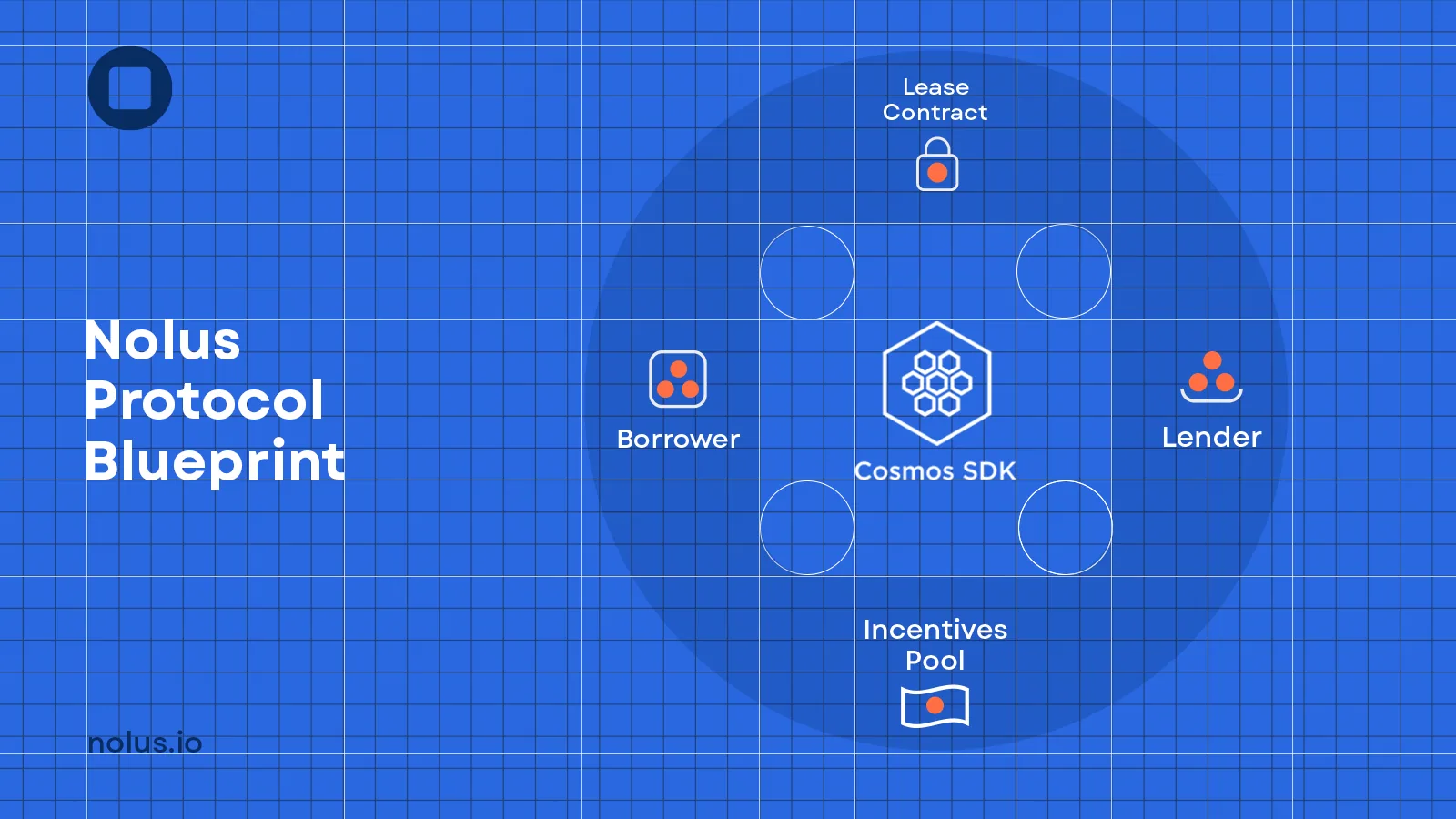
Nolus: Built on Cosmos SDK
The Nolus Protocol runs on an independent, application-specific blockchain utilizing the Tendermint Core, a blazingly fast Proof-Of-Stake consensus algorithm with built-in multi-chain interoperability delivered by the Cosmos SDK. This provides 3 major benefits:
- Transactions can be as cheap as $0.01;
- A censorship-resistant experience with self-custody of funds;
- Inherit the Cosmos blockchain’s robust infrastructure that is interoperable with other decentralized networks on IBC.
The protocol logic is developed in Rust and executed within the isolated sandboxing model by CosmWASM. This enforces robust security and multi-chain compatibility, where each margin position runs in its own contract instance.
The Margin Position
Moving onto our products, the margin position defines a money market between lenders looking to earn a yield on stablecoins, and borrowers aiming to borrow more digital assets than their current equity. To borrow assets, borrowers provide a down payment and can take exposure of up to 5x their equity, depending on the market.
The borrower specifies the exact parameters of the agreement which includes:
- The asset to receive;
- The amount of the down payment.
Once the margin position is initiated, a smart contract instance is created using the previously agreed-upon parameters. The smart contract factory, which produces all margin positions, will then deposit the down payment and the loaned amount into the instance.
Interchain Accounts
Nolus leverages interoperability through Interchain Accounts (ICA), which allows Cosmos sovereign chains to do more than just send assets via IBC to one another. The Nolus Protocol uses a customized version of this module which is better tailored to our products for a few reasons. For example, every smart contract instance has the ability to open an account on host networks where it can perform different actions like swaps, position liquidations, staking, minting derivatives, etc., giving Nolus the ability to stay platform neutral (mitigating external risk) while leveraging functionalities from different permissionless chains.
Nolus first integrated the Osmosis ICA host network, the leading decentralized exchange in the Interchain ecosystem which acts as an Automated Market Maker (AMM) hub, and has since expanded to Solana, where swaps route through an aggregated network of AMMs. Every margin position performs its swap to the desired asset through the liquidity venue of its network, and liquidations happen through the same route.
Liquidation Mechanism
To explain this effectively, it is appropriate to use an example. Let’s say you have $100 worth of SOL and decide to deposit it into Nolus Protocol as a down payment. You then take out a loan of $150 against it, resulting in a margin position that contains $250 worth of SOL in total.
If the price of SOL begins to fall, Nolus will send you reminders when your loan is approaching a margin call, giving you time to provide more collateral or pay off your loan. However, if the price continues to fall around 40%, the value of the SOL within your margin position would slowly approach the value of the initial loan Nolus provided ($150). If the two were to have equal value, or worse, if the value of your collateral was worth less than the loan provided by Nolus, bad debt would begin to accrue on the platform.
To avoid bad debt accruing to the money market, a partial liquidation will occur to return your LTV (loan-to-value) ratio to a safe level. This is usually around ⅓ to ¼ of your position, depending on the collateral type you provided. Additionally, any unpaid interest that accrued to your loan will be paid off in this partial liquidation too.
Liquidations are automatically instantiated by the Nolus smart contracts that sell part of the collateral on the position’s connected liquidity venue. The capital received from selling this collateral within the margin position, including any interest accrued on the loan, is returned to the Liquidity Provider Pools from which the original loan came from.
If the price of SOL continues to decrease, Nolus will eventually liquidate your entire loan yet there should be ample opportunity to pay off your loan before this.
Tailor-made L1
Nolus is built with interoperability at heart. For this reason, the protocol can operate on any compatible general-purpose blockchain without needing its own proprietary layer 1 solution. Yet, Nolus goes beyond this by adopting a more tailored approach that offers its users a greater value proposition. We achieve this by relying on the modular architecture of the Cosmos SDK that allows developers to design the underlying system in a flexible way.
All functionalities on the platform are specifically adjusted to ensure a sustainable economic model for all stakeholders, from stakers to lenders and borrowers. For example, three revenue streams will automatically buy back NLS tokens on the open market and refill the Lender’s Incentive Pool, thus guaranteeing the long-term vision of attracting Lenders. With the adoption of the protocol and increased TVL, larger token buybacks will occur and more rewards will be distributed to lenders.
Conclusion
In summary, Nolus Protocol provides a safe and robust infrastructure that provides users with fixed-interest loans carrying up to 5x exposure, well beyond the market average. These loans experience a lower liquidation risk, and the protocol will remind you when you are close to a margin call to promote a safe borrowing environment.
Nolus takes this experience one step further by taking advantage of the revolutionary technology provided within the Cosmos ecosystem. Interchain accounts will allow Nolus to integrate with many different DEXs in the future on host networks, starting with Osmosis upon launch. Interoperability is extremely important to us, so hopefully you can see that Nolus has been built in a way that is conducive to two-way communication between our protocol and other networks. We look forward to you joining us soon!
Check our main channels here:
Frequently asked questions
Can I use leverage while keeping control of my private keys?
Yes. Nolus is a self-custody protocol: positions are opened through smart contracts from your own wallet, and there is no custodial account to fund or operator-controlled deposit address. Your keys stay with you for the life of the position.
What chain does Nolus run on, and why its own chain?
Nolus is a sovereign appchain built with the Cosmos SDK, with protocol logic written in Rust and executed in CosmWasm. Running its own chain means Nolus never competes for block space with unrelated applications, which matters when a congested block could delay a liquidation or a repayment. It also lets the protocol ship modules a general-purpose chain would not offer.
If the loan is in stablecoins, how does Nolus buy the asset I want?
Borrowed stablecoins are swapped into your chosen asset on an integrated decentralized exchange or aggregator on the host chain. The same channel runs in reverse when part of a position has to be sold. Staying venue-neutral this way lets Nolus add venues without changing how positions work.
Does Nolus close a whole position at once?
Not as a first response. When the loan-to-value ratio crosses the threshold, a partial liquidation sells a portion of the collateral to restore a healthy level and settles accrued interest at the same time. Full closure only happens if price keeps falling and the position is never restored.