Live supply and protocol data
- Circulating supply
- –
- Total supply
- –
- Total value locked
- –
NLS is the native token of the Nolus blockchain — a Proof-of-Stake Layer 1 built with the Cosmos SDK, on which the Nolus money market and its spot margin product run. This page is the reference for what the token does, how staking works, how supply is structured, and where the market numbers stand.
How Does Nolus Work? Fixed-Rate Spot Margin, Explained Step by Step
A plain walkthrough of a Nolus position: how the fixed borrowing rate is set, how leverage is capped, how lenders get paid, and how buybacks fund the rewards.Read moreWhat NLS Is Used For
The token supports four functions on the network:
- Network fees. NLS is the medium for transaction fees and other network usage fees, paid by users to the validators that run the chain.
- Staking and governance. Holders stake NLS to secure the chain and to vote on proposals such as parameter changes and protocol upgrades.
- Consensus incentives. NLS rewards validators and delegators for maintaining the integrity of the network. Rewards are distributed automatically according to parameters set by the network.
- Ecosystem rewards. NLS is used to reward contributors and participants who support the growth of the network.
Staking NLS
Proof-of-Stake weighs a validator's influence by the value delegated to it rather than by the number of machines it runs, which makes an attack expensive rather than merely inconvenient. Delegating NLS to a validator contributes to that security budget and earns a share of emissions and transaction fees in return.
Three chain parameters are worth knowing before delegating, all of them readable from the public Nolus node API:
- Unbonding period: 21 days. Undelegated tokens are neither transferable nor reward-earning until the period elapses.
- Active set: 30 validators. Delegating outside the largest few spreads stake and reduces the number of operators who would have to collude to attack the chain.
- Bonded denomination:
unls, the base unit of NLS at six decimal places.
Staked tokens are also subject to slashing, the mechanism by which a validator that misbehaves loses a percentage of its stake — delegators share that loss, which is why validator selection matters.
What Makes Staking an Attractive Proposition On Nolus?
Proof-of-Stake acts as a Sybil-protection mechanism.Read moreHow Value Accrues to NLS
Beyond fees and emissions, the token model defines three routes by which protocol activity is meant to reach the token.
Adjusted spot margin interest
Staked NLS grants borrowers lower interest rates on margin positions. The reduction is calculated from staking duration — the longer the stake, the lower the interest on subsequent positions. Undelegating resets the rate to the base rate regardless of the amount.
Tiered lender APR
Lenders buy and stake NLS to raise the rewards on the stablecoins and tokens they supply. As protocol usage grows, reaching a higher APR tier requires more NLS, tying token demand to the size of the money market.
Spot margin revenue and buybacks
Most protocol revenue comes from interest-bearing margin position contracts. Part of operating income is used to buy NLS on the open market, which is then added to the Nolus Incentives Pool and paid out as lender rewards. This is an indirect benefit rather than a direct distribution: revenue does not flow to stakers as revenue, it flows as open-market demand for the token.
Supply Structure
The maximum supply is capped at 1 billion NLS. 850 million were issued and allocated at the genesis block, most of them locked — locked tokens can be staked but cannot be spent or transferred until released by their schedule.
| Allocation | Share | Release schedule |
|---|---|---|
| Community (DAO treasury) | 24% | Linear vesting over 36 months from genesis |
| Token sale | 20% | 9-month cliff, then 24 months linear |
| Team and contributors | 19% | 15-month cliff, then 36 months linear |
| Lender incentives | 12% | Liquid at genesis; distribution follows protocol activity |
| Strategic partners | 5% | 9-month cliff, then 24 months linear |
| Liquidity | 4% | Liquid after genesis |
| Bug bounty | 1% | Liquid after genesis |
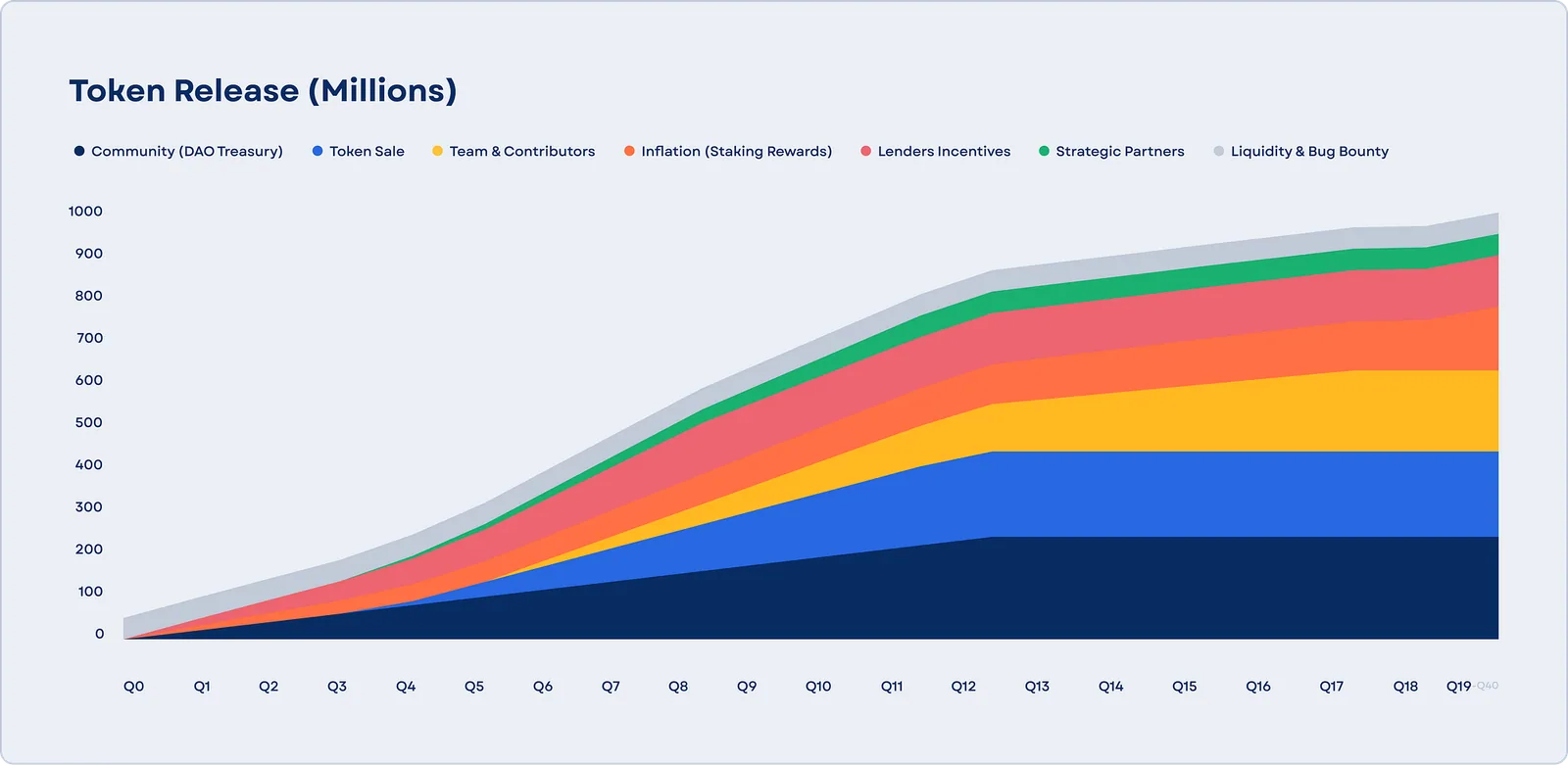
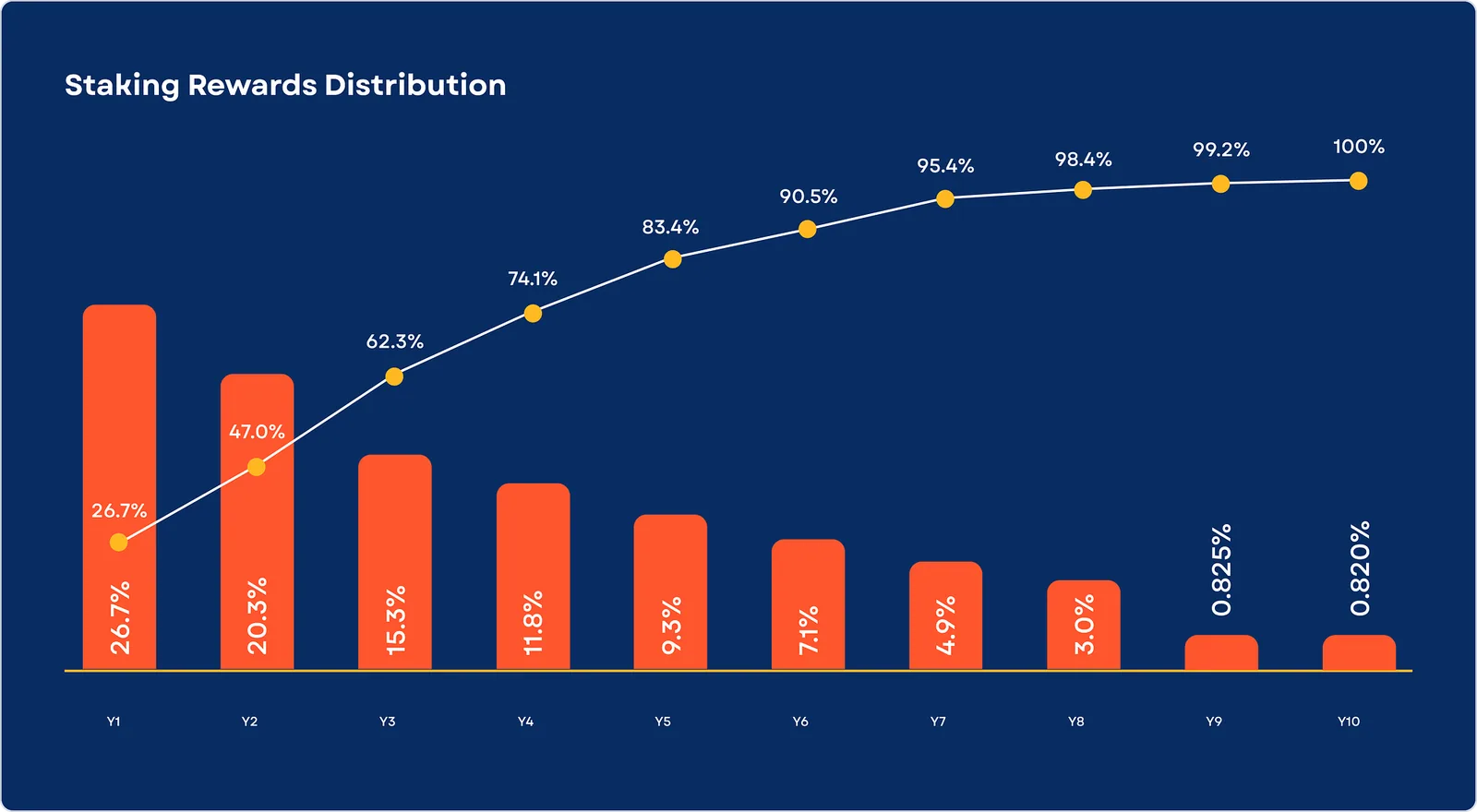
The remaining 150 million NLS — 15% of the total supply — are minted over ten years as staking rewards for validators and delegators. Under the schedule set at genesis, 2.5% of all tokens are minted at the end of the first month of operations, and the monthly rate then steps down by 0.05 percentage points per month through year one, by 0.04 pp in year two, 0.03 pp in year three, 0.02 pp in year four, 0.015 pp in years five through seven, and 0.0125 pp in year eight, remaining constant to the end of year ten.
Circulating supply is therefore the released portion of the genesis allocation plus everything minted as staking rewards since. In September 2024 the team put a signaling proposal to governance to reshape that emission curve — emitting less in the near term and more later, so that supply enters circulation as the ecosystem grows. The proposal and both curves are described in full in the post below; check the on-chain governance record for the parameters currently in force.
Revamping Nolus Chain Inflation for Long-Term Growth
The NLS token serves as the backbone of the Nolus ecosystem, driving key operations such as gas fee payments on the Nolus chain, networkRead moreNLS Market Data
The panel at the top of this page reads three headline figures live on every page load: circulating supply, total supply, and total value locked. The table below is a fuller snapshot taken on 6 August 2026 — it adds market pricing, the vesting reserve, burned supply and the 1 billion cap, and it does not move.
Supply comes from the Nolus supply service, the protocol's own chain-supply endpoint and the source that feeds external aggregators. Market pricing comes from CoinGecko, staking figures from the Nolus chain, and protocol figures from the Nolus data API. Sources are listed at the end of this page.
| Metric | Value (as of 6 August 2026) |
|---|---|
| Price | $0.0023766 |
| Market capitalisation | $2,099,159 |
| Fully diluted valuation | $2,189,260 |
| 24-hour trading volume | $59,488 |
| Circulating supply | 883,258,451 NLS |
| Total supply | 921,171,101 NLS |
| Reserves (unvested) | 37,912,649 NLS |
| Burned | 0 NLS |
| Maximum supply | 1,000,000,000 NLS |
Two things follow from those numbers. Circulating supply is about 88% of the 1 billion cap, so roughly 12% of the maximum has yet to reach circulation — the reserve still in vesting, plus the remainder of the ten-year staking-reward mint that keeps total supply below the cap. And the fully diluted valuation quoted above is computed against current total supply, not against the cap: priced at the same rate, all 1 billion NLS would come to about $2.38 million, some 13% above market capitalisation.
The gap between total and circulating supply is the reserve still locked in vesting, published as 37,912,649 NLS. The service derives it from the 36 continuous vesting accounts, treating the locked portion of each as min(bank balance, original vesting amount × the fraction of the vesting period still to run) and subtracting the sum from total supply. Each row is floored independently, so subtracting the published reserve from the published total lands one unit away from the published circulating figure. Nothing has been burned.
On the staking side, 238,115,577 NLS were bonded at the time of reading — about 25.9% of total supply, and that share is the network's security budget. A further 45,138,387 NLS sat in the unbonding pool, the module account holding stake part-way through its 21-day exit. The rest, roughly 638 million NLS, is neither staked nor unbonding.
For protocol context on the same date, total value locked stood at $348,805, and cumulative transaction value routed through Nolus Spot Margin and Earn since launch stood at $179,954,913.
These figures move continuously. Treat the table as a dated snapshot rather than a live ticker, and read the current values from the sources below.
Why the Model Is Shaped This Way
Building a token economy means gearing the economics toward specific outcomes from the ground up. For NLS those outcomes are security, longevity, decentralisation, and economic growth.
Keeping the majority of NLS circulating among the community matters for all four: it sustains engagement, keeps investment flowing into the protocol's health, development and security, and provides sufficient liquidity for validators and users. Linear unlocking exists so the token economy does not have to absorb sudden supply shocks before it has had time to mature.
None of these parameters are fixed forever. On-chain governance can adjust token economics — including inflation rates — and anyone who stakes NLS is eligible to vote on those changes. Agreed changes still require validator adoption to take effect.
Sources
- Nolus supply service — circulating, total, maximum and burned supply, the reserve figure, and the vesting-lock methodology. Read 6 August 2026.
- CoinGecko — Nolus (NLS) — price, market capitalisation, fully diluted valuation and 24-hour volume, read 6 August 2026.
- Nolus chain API — bonded and unbonded stake; unbonding period and active-set size from
/cosmos/staking/v1beta1/params. Read 6 August 2026. - Nolus data API — total value locked; cumulative transaction value from
/api/total-tx-value. Read 6 August 2026.
Frequently asked questions
What is the NLS token?
NLS is the native token of the Nolus blockchain, a Proof-of-Stake Layer 1 built with the Cosmos SDK. It pays network transaction fees, secures the chain through staking, carries governance voting rights, and is used to reward ecosystem contributors.
What is the maximum supply of NLS?
The maximum supply is 1 billion NLS. 850 million were allocated at genesis across community, investor, team, lender-incentive, partner, liquidity and bug-bounty pools, and the remaining 150 million are minted over ten years as staking rewards.
Can NLS be staked?
Yes. NLS holders delegate to validators to help secure the network and earn a share of emissions and transaction fees. Undelegating is subject to a 21-day unbonding period, during which the tokens neither earn rewards nor can be transferred.
How do I use NLS to vote on proposals?
Voting power comes from staked NLS, so you must delegate to a validator before you can vote. Once delegated, you can vote on any proposal in its voting period, and your vote overrides your validator's vote for your share of the stake. Undelegated NLS carries no voting power.
What happens if I stake but never vote?
Your validator votes with your delegated stake by default, so your tokens still count toward quorum. You keep the ability to override that vote on any individual proposal while its voting period is open.