Strategy 1: Opening a leveraged long position
This will be a recap for most, and an update to the original strategies on Nolus Protocol guide. Nolus allows users to open a long position. This strategy is profitable for those expecting an upward movement in the price of an asset (or would like to hedge against this movement). An increase in the value of the borrowed asset will enable the user to make a greater profit than simply holding their asset.
For example, if Alice holds $2,000 in ATOM and is convinced that the price will increase, she could open a margin position to borrow up to $3,000 in ATOM with her ATOM as collateral.
If the price of ATOM was to increase by 10%, Alice would have made a profit of $200 by simply holding her ATOM. By using a margin position, Alice’s profit increases to $500 less any interest costs.
Furthermore, users can make this strategy more efficient by using an LST such as stATOM as their collateral to earn staking rewards while they are exercising their leveraged long position. The effectiveness of this optimization can be seen below:
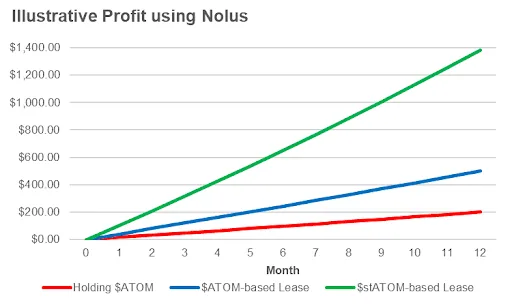
The above chart assumes a constant percentage growth in the price of $ATOM per month resulting in an overall 10% price gain over the year. It also assumes a 15% annual staking yield that is compounded monthly (though Stride and other derivative providers will compound far more frequently than that).
The red and blue lines in the chart show a user simply holding $ATOM and having a leveraged long position on $ATOM through Nolus. This results in an extra 150% profit to the user (net of interest costs)!
However, the green line shows the powerful impact of combining Nolus with LSTs. By opening a margin position with $stATOM as collateral and borrowing $stATOM, the extra profit skyrockets to 592% over the year!
Strategy 2: Opening a leveraged short position
Conversely, the same concepts apply to opening a leveraged short position for an asset. This strategy is profitable for those expecting a downward movement in the price of an asset (or would like to hedge against this movement). A decrease in the value of the borrowed asset will enable the user to make a greater profit than simply engineering a spot short (by selling their asset to re-buy at a future date).
For example, if Bob holds $5,000 in BTC and is convinced that the price will decrease, he could open a margin position to borrow up to $7,500 in BTC with his BTC as collateral.
If the price of BTC were to decrease by 10%, Bob would have made a profit of $500 by simply selling his BTC and rebuying it at a later date. By using a margin position, Bob’s profit increases to $1,250 less any interest costs.
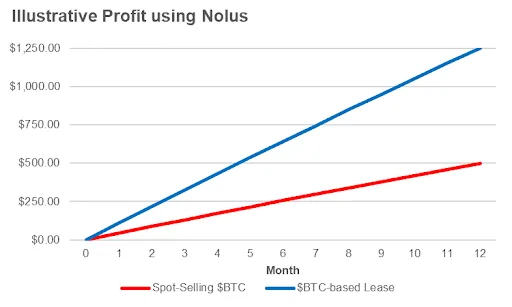
Similar to Strategy 1, the red and blue lines in the chart show a user simply spot-selling $BTC and having a leveraged short position on $BTC through Nolus. This also results in an extra 150% profit to the user (net of interest costs)!
Strategy 3: Adding value to a Money Market position
Users may use a money market for a variety of reasons (i.e., incentivized deposits and borrowing that subsidize interest costs). The “traditional” mechanism for creating a short, or a long, on a lending protocol can be amplified by combining it with Nolus.
For example, if Charles holds $1,000 in USDC and believes that the price of ATOM will decrease, he could leverage a money market to borrow ATOM (which is then sold for USDC) by using his USDC as collateral.
Charles could re-deposit the borrowed USDC on a money market to take out more ATOM. However, this would increase his leverage and risk, which he may not be comfortable with.
Alternatively, Charles could deposit this USDC in the Liquidity Providers’ Pool (see Strategy 5 below) to earn some additional income while executing this strategy (that could partially offset his interest costs).
This strategy can also be executed with an artificial long position from a money market. For example, if Damien held $500 in SOL and believed that the price of SOL would increase, he could borrow USDC using his SOL as collateral and purchase SOL using his USDC.
This SOL can also then be deposited into the Liquidity Providers’ Pool on Nolus where it can earn income that can pay off its interest costs from the money market.
This strategy is useful for risk-averse market participants who are not seeking high-leverage positions.
Strategy 4: The “Power Hedgooor”
Delta-neutral strategies are those that earn yield while removing the risk associated with any price movement in the underlying asset used. They typically earn lower yields than risk-on strategies on the upside but are protected against the downside (unlike more risk-based strategies).
A typical example of this would be to have a long position against stATOM while having a short position against ATOM. Should the price of ATOM increase, the long would become more profitable, while the short would become loss-making, and vice versa. With the ATOM price movements being offset, the user can earn staking income with minimal concern for price risk.
While users could previously create this strategy by combining Nolus (to create a long position), and a money market (to create a short position), this was less capital efficient than what is now possible due to the requirement of overcollateralisation on a traditional money market.
This can be demonstrated as follows:
- To create a $10,000 leveraged long position using Nolus, Erika would require $4,000 in capital. To create a $10,000 short position using a money market, Erika would require $13,000 in capital (assuming 130% collateralization requirements)
This totals $17,000 in capital compared to the $8,000 capital required if both positions (long and short) were created using Nolus. Consequently, Nolus allows users to execute this delta-neutral strategy with 53% less capital required.
Strategy 5: The “Power Leveragooor”
This strategy looks to build on both Strategy 1 and Strategy 2, but seeks to allow users to amplify their leveraged position even further! This combines a money market and Nolus to grow a user’s leverage further than that which either primitive could do alone.
As an example, let’s assume that Frank has $13,000 in ATOM and wishes to leverage his position. However, he is aware of the risks associated with perpetual protocols and wishes to not use them.
- Frank has the option of depositing his ATOM in a money market to borrow a stablecoin. Assuming a healthy collateralization ratio of 130%, he could borrow $10,000 and purchase more ATOM using these proceeds. This would give him a total of 1.77x leverage
- Alternatively, Frank could simply open a margin position on Nolus which would give him a 2.50x leverage
However, this strategy sees Frank deposit his ATOM in a money market, purchase more ATOM with the borrowed USDC, and then deposit this ATOM in Nolus to open a position. This would increase his exposure to ATOM to $38,000 giving him a total exposure to ATOM of 2.92x.
This strategy could be executed both as described above (to long a specific asset) or to short an asset.
Strategy 6: Depositing to the Liquidity Providers’ Pool
This is a neutral strategy that does not rely on the market to move in a specific direction. Users can deposit an assortment of assets that Nolus will use when opening margin positions for users.
This includes variants of USDC that Nolus uses when opening long positions. It now also includes stATOM, BTC, SOL, and AKT, which Nolus uses when opening short positions.
By depositing these assets to the Liquidity Providers’ Pool, users can earn passive income from the interest borrowers pay on their positions.
Closing Thoughts
Nolus’ core product provides mechanisms for all market participants to earn yield. From depositing in the Liquidity Providers’ Pool to opening leveraged positions that are long or short a specific asset.
As Nolus continues to grow with newer products deployed on it, new strategies will be found for users, and yield will continue to grow to make Nolus even more attractive for market participants.
Frequently asked questions
What positions can I open on Nolus?
Long and short. A leveraged long borrows to buy more of an asset you expect to rise; a leveraged short borrows the asset you expect to fall. Both draw on the same shared liquidity pool and carry the same fixed-rate mechanics, with partial liquidation as the first response when a position crosses its threshold.
Do I have to take a directional view to use Nolus?
No. Depositing into the Liquidity Providers' Pool is a neutral position: you earn interest paid by borrowers without taking a side on price. The trade-off is that you carry the pool's exposure to drawdowns fast enough to outrun liquidation.
Can I earn staking rewards while running a leveraged position?
Yes, by using a liquid staking token as your collateral and as the borrowed asset. Staking yield then accrues across the whole position rather than only your own capital, offsetting part of the interest cost. It also adds the liquid staking token's own risks, including divergence between it and the underlying asset.
What is a delta-neutral strategy on Nolus?
Holding a long on a liquid staking token against a short on its underlying asset cancels most of the price exposure while leaving the staking yield. Running both legs on Nolus needs considerably less capital than pairing a Nolus long with an over-collateralized short on a traditional money market, because the short leg is not over-collateralized.