IBC has been the Cosmos ecosystem’s long-standing foundation for secure, trust-minimized interoperability. Since its launch in 2021, it has processed tens of millions of cross-chain messages without a custodial failure, establishing itself as one of the most reliable interoperability standards in production. Unlike traditional bridges that rely on multisigs or external operators, IBC uses on-chain verification: each chain maintains a light client of the other and validates block headers, proofs, and signatures before any message is accepted.
This design allows independent chains to exchange verifiable state updates under the same security assumptions that protect their own consensus. IBC is the backbone of Cosmos interoperability and a proven model for trust-minimized communication between sovereign blockchains.
But interoperability within Cosmos alone is no longer enough.
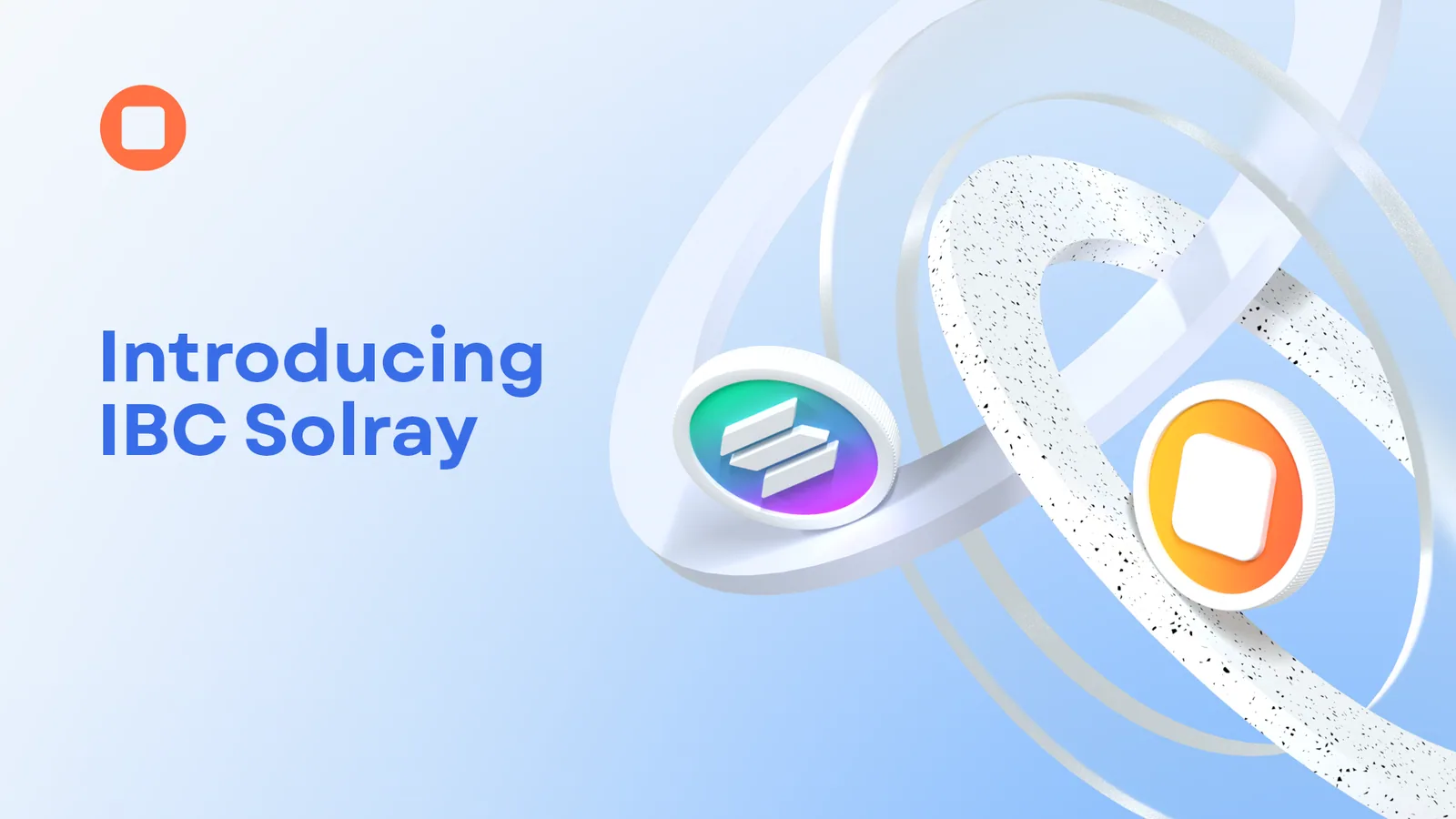
Introducing IBC Solray
Solray extends the IBC model to Solana. It implements IBC’s verification and messaging semantics inside a single Solana program, enabling Solana to function as a first-class participant in the IBC network. Solray establishes:
- Light client on Solana that verifies messages and proofs originating from any Cosmos chain
- Solana light client hosted on Cosmos networks through the standard IBC module
- Channel and packet handling adapted to Solana’s account model and execution environment
Together, these components create a symmetric, trust-minimized communication layer where Solana and Cosmos chains authenticate each other directly without custodial bridges, cross-chain committees, or added trust assumptions.
Hermes-lite
IBC relies on neutral relayers to transport packets. Relayers cannot modify messages, access funds, or influence verification. They simply observe events on one chain and forward the corresponding packets to another.
Cosmos chains commonly use Hermes, the production-grade relayer developed and maintained by Informal Systems. To support Solray, we are building Hermes-lite, a stripped-down fork of Hermes with a focused mandate: efficient, reliable packet relaying between Cosmos chains and Solana.
Hermes-lite removes support for less common or specialized IBC functionalities, such as non-standard IBC implementations, CCV modules, ICQ modules, fee repayer logic, ICA modules, and other auxiliary tooling, so the codebase stays lightweight and operationally simple. The result is a relayer focused on what matters most for Solray: robust, trust-minimized packet forwarding between chains, while preserving full compatibility with the IBCv1 standard used across Cosmos today.
What Solray Enables for Nolus
Solray lets Nolus execute cross-chain workflows on Solana without compromising trust minimization. Actions initiated on Nolus, such as opening or closing leverage positions are verified through IBC and executed natively on Solana through programs like Jupiter Ultra.
Illustrative example:
- A user opens a long SOL leverage position using USDC collateral
- Nolus calculates the borrowed amount and sends an IBC instruction to Solana
- A Solray gateway program performs a USDC → SOL swap on Jupiter Ultra and holds the SOL in a position-scoped account
- When the user closes the position, Nolus sends another IBC instruction, the gateway performs the reverse swap and returns funds to Nolus for settlement
The workflow is non-custodial, consensus-verified by both chains, and designed to be seamless from the user’s perspective.
What Solray Enables for Solana and the Cosmos Ecosystem
Solray provides Solana with a direct, trust-minimized connection to the entire Cosmos IBC network.
Solana programs can:
- Receive IBC packets backed by on-chain light-client verification (eg, token transfers, swaps and other types of instructions)
- React to authenticated state changes from external chains
- Integrate Cosmos-based liquidity, data, or application flows without relying on traditional bridge infrastructure
At the same time, Solray becomes available to all +120 IBC-enabled Cosmos chains. Any network can deploy the Solana Light Client and interact with Solana using the same trust-minimized guarantees that Cosmos chains rely on today
This unlocks new cross-chain applications, including:
- Native cross-chain swaps
- Lending markets accessing Solana’s liquidity profile
- Liquid-staking and restaking flows
- Multi-chain yield and routing strategies
- High-performance execution pipelines that combine Solana throughput with Cosmos composability
Disclosure: Solray is currently under active development and remains closed source until the implementation reaches production maturity. The repository will be open sourced once development concludes and has undergone a structured verification cycle to confirm its operational soundness and protocol conformance.